
Magnetic tiles or wooden blocks for spatial learning
Advertisement
Magnetic tiles and traditional wooden blocks both foster early spatial reasoning, but they teach children different foundational concepts through distinct physical feedback. Choosing between them depends on whether your immediate priority is helping a child understand gravitational balance and hand-eye coordination or geometric relationships and rapid structural design.
This comparison helps parents and caregivers select the most effective open-ended tools for toddlers and preschoolers without buying redundant products. While both options remain staples of early childhood classrooms, their physical properties encourage fundamentally different problem-solving behaviors during daily play.
Understanding spatial reasoning in early childhood
Spatial reasoning refers to the capacity to visualize, manipulate, and mentally transform two-dimensional shapes and three-dimensional objects. When choosing early spatial learning toys, parents often look for materials that prompt children to evaluate proportions, recognize symmetry, and anticipate how parts combine to create wholes. Cognitive development research published by organizations such as the National Association for the Education of Young Children highlights that regular manipulation of solid objects directly supports later achievement in science, technology, engineering, and mathematics.
Advertisement
When an infant or toddler grasps an object, turns it around, and attempts to align it with an adjacent surface, the brain processes complex sensory inputs. The visual system gauges distance, depth, and edge orientation, while the proprioceptive system measures muscle tension, resistance, and weight. Toys that do not dictate a specific outcome through digital sounds or predetermined assembly paths are known as open-ended materials. These items yield the highest density of spatial vocabulary interactions between adults and children, such as over, under, beside, rotate, taller, and inverted.
The core difference between magnetic construction elements and solid timber units lies in the rules of attachment. A child using solid wooden blocks must confront terrestrial physics directly, accommodating downward forces and surface friction. A child using magnetic panels operates within magnetic fields that hold pieces together, allowing for cantilevers, hollow forms, and immediate upward construction that would collapse under standard gravity alone.
How wooden blocks build physical and motor foundations
Traditional unit blocks have served as foundational learning apparatuses since educator Caroline Pratt introduced them to early education curricula in the early twentieth century. Standard unit blocks use precise mathematical ratios where two quarter units equal a half unit, two half units equal a standard unit, and two standard units equal a double unit. This exact proportional system exposes children to intuitive fraction concepts, volume equivalence, and arithmetic symmetry long before formal classroom instruction begins.
Because solid hardwood blocks rely entirely on friction and gravity, they impose strict physical consequences for poor alignment. If a toddler places a cylinder or cuboid slightly off-center on top of a narrow pillar, the entire assembly collapses immediately. This instant cause-and-effect relationship cultivates fine motor precision, impulse control, frustration tolerance, and an intuitive grasp of center-of-mass dynamics. Children must moderate their hand speed, stabilize their posture, and carefully position each piece without disturbing previous layers.
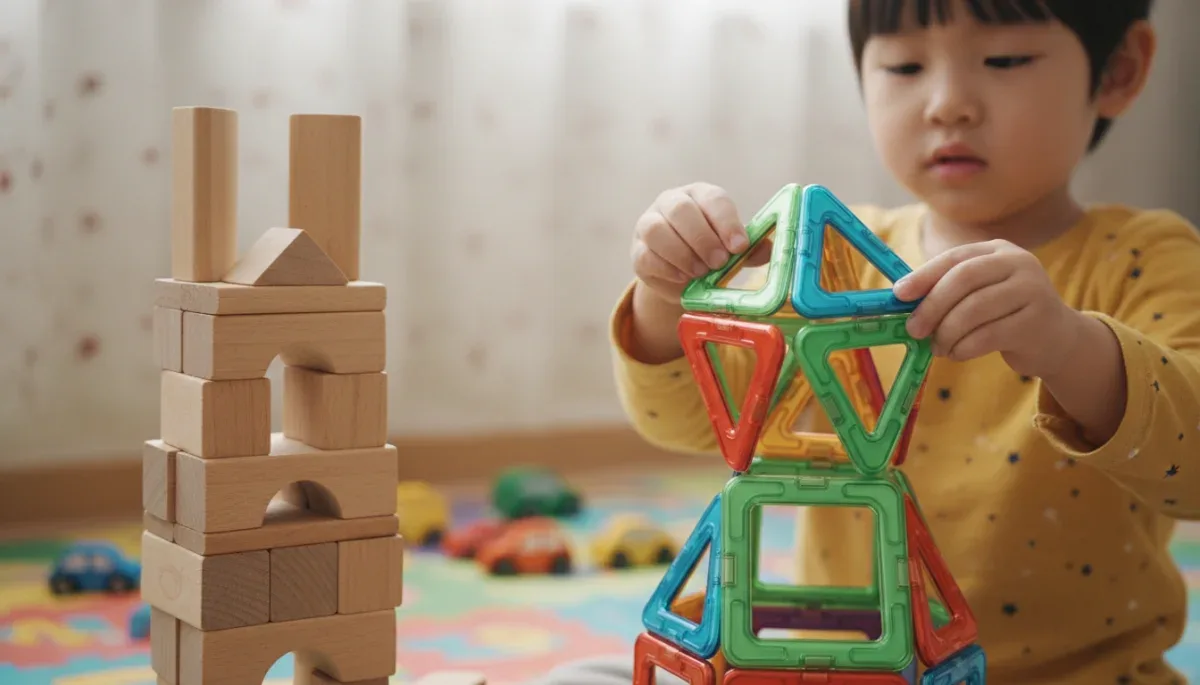
Key developmental skills fostered by wooden blocks
- Precision motor control: Placing non-locking objects requires deliberate hand stabilization and exact spatial placement.
- Intuitive mass comprehension: Solid wood pieces convey distinct differences in weight proportional to their physical volume.
- Fractional volume relationships: Unit blocks demonstrate visually that multiple smaller components precisely match larger ones.
- Failure recovery: Collapses happen naturally, encouraging resilience and iterative structural redesign.
The sensory profile of natural wood also provides valuable cognitive input. The density of untreated or lightly finished maple, beech, or birch communicates real-world mass. When a child knocks down a wooden tower, the sound provides auditory feedback about the density of the material and the force of the impact, grounding the child's understanding of the physical environment in tangible reality.
How magnetic tiles encourage geometric and architectural thinking
Magnetic tiles, constructed from durable plastic shells enclosing internal neodymium magnets along their perimeters, introduce children to surface geometry and planar transformations. Because the edges contain spinning magnets that orient themselves automatically to prevent polarity repulsion, children can snap shapes together instantly along any edge. This reduces initial mechanical friction and allows younger toddlers to build vertical walls and multi-sided enclosures before they possess the fine motor calibration needed for delicate block stacking.
The standout spatial benefit of magnetic panels is the seamless transition between two-dimensional nets and three-dimensional polyhedra. A preschooler can lay six square tiles flat on a rug in the shape of a cross, lift the outer panels upward, and watch the flat pattern fold instantly into a hollow three-dimensional cube. This visual and tactile conversion directly mirrors the geometric principles taught in elementary geometry curricula, giving children an early intuitive mental model for surface area and volume.
Distinct cognitive advantages of magnetic tiles
- Two-dimensional to three-dimensional translation: Children assemble flat nets that easily pull up into standing geometric solids.
- Exploration of hollow space: Thin walls allow children to construct interior rooms, tunnels, and light-filtering vessels.
- Understanding structural tension: Triangular bracing demonstrates how diagonal supports create rigid and stable architectural frames.
- Rapid design iteration: The magnetic cohesion allows fast construction and immediate spatial reorganization without accidental collapses.
Translucency adds an extra educational layer to magnetic tiles. Children frequently position them against sunny windows, light tables, or household lamps to explore color mixing, ray projection, and shadow formation. Viewing the interior volume through clear tinted plastic helps children understand that spatial enclosures have internal dimensions that can be filled, partitioned, or illuminated.
Safety considerations and durability standards
When selecting early spatial learning toys, parents must evaluate structural integrity and safety standards established by regulatory authorities. In the United States, the Consumer Product Safety Commission sets rigorous mechanical requirements for children's products under the ASTM F963 toy safety specification. High-powered small magnets present severe internal injury risks if ingested, making construction quality paramount when purchasing magnetic sets for young households.
Reputable magnetic tile manufacturers employ ultrasonic welding and metal perimeter rivets to permanently enclose the internal magnets within impact-resistant ABS plastic shells. Cheap imitation brands sold on direct-to-consumer online marketplaces sometimes omit metal rivets or use brittle plastics that crack when dropped on hard tile floors. Caregivers must regularly inspect magnetic toys for hairline fractures, loose edges, or worn seams, discarding any compromised unit immediately to prevent magnet detachment.
Solid wooden blocks present virtually zero ingestion hazard provided they exceed federal small parts choke tubes, typically measuring at least 1.25 inches in diameter for children under three years of age. Quality hardwood blocks carved from solid maple or beech do not chip, splinter, or degrade under typical use, frequently surviving across multiple generations without loss of structural utility. The main safety issue with wooden blocks stems from their physical mass; heavier double and quadruple units can cause minor bruising or foot injuries if dropped from elevated tables or thrown during energetic play sessions.
Combining both materials for open-ended play
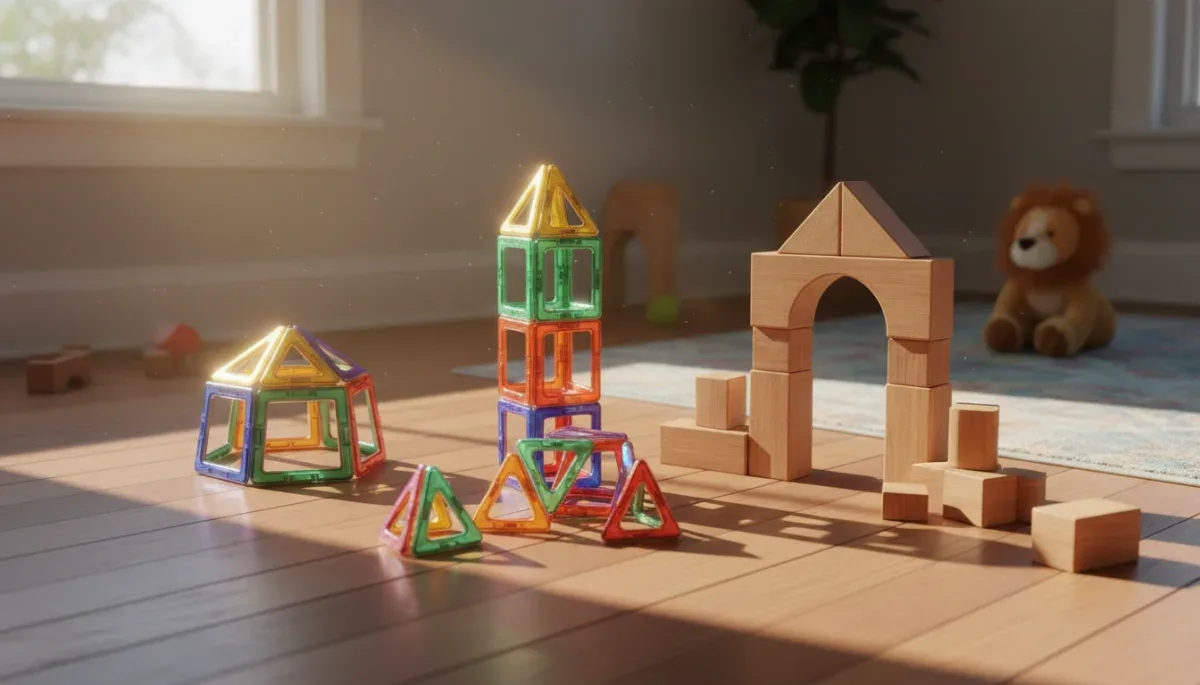
Early childhood educators frequently note that magnetic tiles and wooden blocks are complementary rather than mutually exclusive. Integrating both materials into a shared play environment expands the scope of spatial experimentation beyond what either toy achieves independently. When children combine materials, they learn to balance the structural benefits and mechanical limitations of different mediums.
A typical hybrid construction project involves using dense wooden blocks to form solid foundations, retaining walls, bridge pilings, and road networks, while utilizing magnetic tiles to assemble roofs, cantilevers, decorative facades, and multi-story towers. The heavy wood anchors the structure against unintended table bumps, while the lightweight magnetic elements permit sweeping arches and enclosures that wooden gravity blocks cannot support without complex scaffolding.
This combined approach also mirrors professional engineering practices where composite materials are chosen for their specific physical properties. Children quickly deduce that heavy, opaque blocks make sturdy lower levels, whereas light-transmitting magnetic panels serve better for observation decks, windows, and decorative roofs. Providing storage containers that keep sets separated encourages children to make deliberate decisions about which medium to retrieve for a specific architectural goal.
Choosing the right set for your home and budget
Investing in durable play equipment requires balancing space constraints, budget allocations, and the specific developmental window of your children. Solid hardwood unit block sets represent a substantial upfront expense due to timber processing, weight, and milling tolerances. However, because they are virtually indestructible and free from mechanical joints, their cost per year of use drops dramatically over time, often serving through childhood and into future generations.
Magnetic tiles generally come in entry-level packs of thirty to one hundred pieces, with base sets costing less than comprehensive hardwood collections. However, because each magnetic shape is thin, constructing meaningful three-dimensional structures requires a higher piece count. A basic thirty-piece set is often exhausted after building one modest house, prompting many families to purchase add-on sets, specialty wheel bases, and large foundation plates to support advanced construction as their children grow.
Consider your primary play surface before finalizing an investment. Wooden blocks perform best on firm, non-carpeted surfaces such as hardwood, linoleum, or dense low-pile rugs where level ground preserves balance. Magnetic tiles, by contrast, tolerate plush rugs and uneven surfaces much better because the magnetic bonds secure adjacent pieces regardless of slight variations in floor angle.
At a glance
| Feature | What to know |
|---|---|
| Primary spatial concept | Wood teaches gravitational balance; tiles teach geometric transformation. |
| Fine motor demand | Blocks require strict hand steadiness; tiles snap together easily. |
| Long-term durability | Hardwood lasts decades; plastic tiles wear and require safety checks. |
| Ideal floor surface | Blocks demand firm floors; tiles work on carpets and uneven rugs. |
Frequently asked questions
Which toy is better for an eighteen-month-old toddler?
Wooden blocks are generally better suited for an eighteen-month-old toddler. At this age, children focus on stacking, grasping, and feeling mass. Solid wood provides clear tactile feedback about weight and gravity without the ingestion hazards associated with cracked magnetic toys.
Do magnetic tiles limit a child's understanding of balance?
Yes, magnetic tiles can create unrealistic assumptions about balance because internal magnets hold precarious structures together. If children only build with magnetic tiles, they miss learning how gravity, friction, and centered alignment govern physical construction in the real world.
What wood type makes the best traditional blocks?
Solid rock maple and European beech make the highest quality building blocks. These dense hardwoods resist denting, avoid splintering over decades of impact, and provide consistent, predictable weight across standardized unit pieces used for early proportional learning.
Can magnetic tiles and wooden blocks be used together safely?
Yes, children can combine them safely under standard adult supervision. Mixing materials teaches composite engineering, letting children use heavy wood blocks for solid structural foundations and magnetic tiles for lightweight roofs, colorful bridges, and decorative exterior paneling.
The bottom line
Wooden blocks cultivate motor precision, patience, and balance under pure gravity, while magnetic tiles excel at teaching geometric nets, symmetry, and architectural volume. Neither material is universally superior; their value depends entirely on the developmental skills your child is exploring today. Before purchasing either option, inspect your available floor space and check that the product displays certified ASTM F963 safety compliance markings from an official testing laboratory.
Written by
Rita Lima
Rita Lima writes about conscious living and personal growth for portalreborn.com. Each article explains how things work, compares published details such as prices, policies and program rules, and points readers to the official source before they decide.