Future of Education: U.S. School Innovations by 2026
Advertisements
The future of education in U.S. schools by 2026 is being reshaped by five critical innovations, including artificial intelligence, virtual reality, and competency-based learning, which are enhancing engagement and preparing students for dynamic futures.
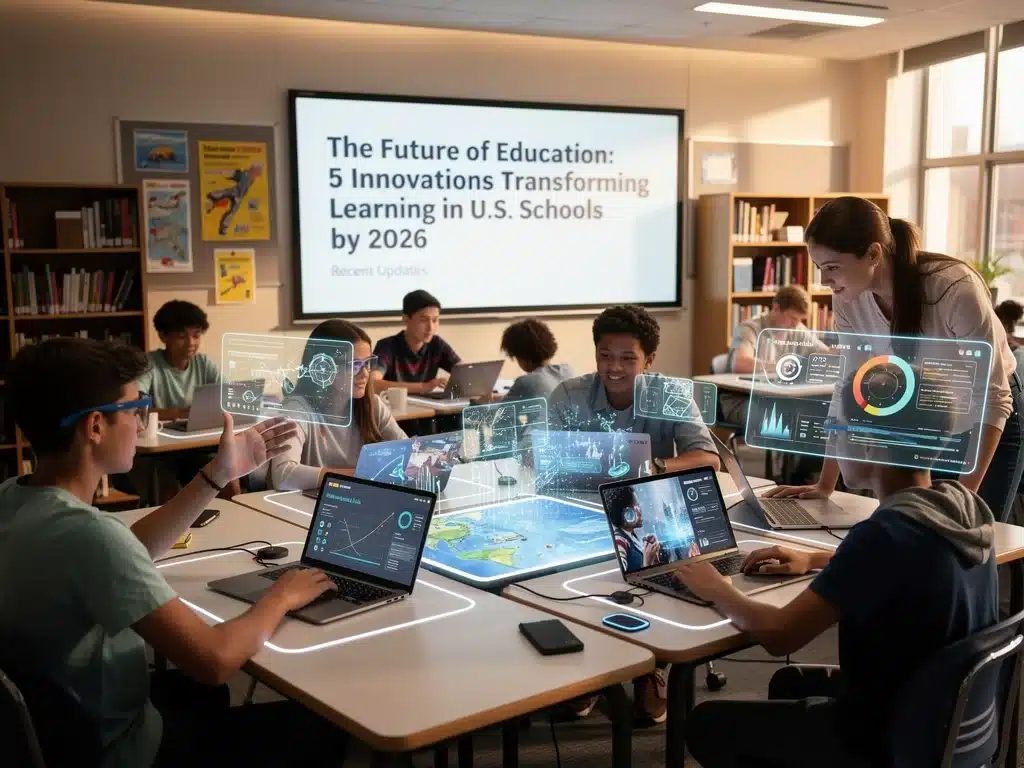
The landscape of learning is always evolving, but the pace of change has accelerated dramatically. By 2026, the future of education: 5 innovations transforming learning in U.S. schools will profoundly redefine how students engage with knowledge and develop essential skills. This shift isn’t just about integrating new gadgets; it’s about fundamentally rethinking pedagogical approaches and creating more dynamic, equitable, and effective learning environments.
Advertisements
Artificial intelligence and personalized learning pathways
Artificial intelligence (AI) is rapidly moving beyond experimental phases to become a cornerstone of personalized learning in U.S. schools. This innovation promises to tailor educational content and pace to each student’s unique needs, strengths, and learning styles, creating an unprecedented level of individualized instruction.
AI-powered platforms analyze student performance data in real-time, identifying areas where a student might struggle or excel. Based on this analysis, the system can recommend specific resources, practice exercises, or even alternative explanations, ensuring that no student is left behind or held back. This adaptability allows educators to focus more on mentorship and complex problem-solving rather than rote instruction.
Adaptive curriculum delivery
One of AI’s most significant contributions is its ability to deliver an adaptive curriculum. Imagine a math program that adjusts its difficulty based on a student’s immediate responses, offering extra support for tricky concepts or accelerating through mastered topics. This dynamic approach keeps students challenged and engaged.
- Real-time feedback: AI tutors can provide instant, constructive feedback on assignments, helping students understand errors immediately.
- Content curation: Algorithms can suggest articles, videos, and interactive simulations relevant to a student’s current learning objective.
- Progress tracking: Detailed analytics help both students and teachers monitor growth and pinpoint areas for improvement.
Furthermore, AI can help identify learning disabilities or specific cognitive patterns earlier, allowing for timely interventions and more targeted support services. This proactive identification is crucial for ensuring equitable access to quality education for all students.
The integration of AI also extends to administrative tasks, automating grading for certain types of assignments and freeing up teachers’ time. This allows educators to dedicate more energy to one-on-one interactions, curriculum development, and fostering a supportive classroom community. The promise of AI in personalized learning is not to replace teachers, but to augment their capabilities, making education more efficient and effective.
Virtual and augmented reality for immersive experiences
Virtual Reality (VR) and Augmented Reality (AR) are poised to revolutionize how students interact with educational content, moving beyond passive consumption to active, immersive experiences. These technologies offer unparalleled opportunities to explore complex subjects in engaging and memorable ways, transcending the limitations of traditional textbooks and classroom walls.
Imagine dissecting a virtual frog without ethical concerns, exploring ancient Rome in 3D, or conducting dangerous chemical experiments in a safe, simulated environment. VR and AR make these scenarios possible, bringing abstract concepts to life and fostering a deeper understanding through direct experience. This shift from theoretical knowledge to experiential learning is a game-changer for student engagement.
Creating interactive learning environments
AR, in particular, overlays digital information onto the real world, allowing students to point their devices at objects and receive instant information or see 3D models appear in their environment. This can transform a simple classroom into an interactive learning hub, where information is always within reach and contextually relevant.
- Field trips reimagined: Students can ‘visit’ historical sites or distant ecosystems without leaving the classroom.
- Hands-on simulations: Complex scientific processes or engineering principles can be demonstrated and manipulated in a virtual space.
- Skill development: VR can provide safe environments for practicing surgical procedures, flight simulations, or public speaking.
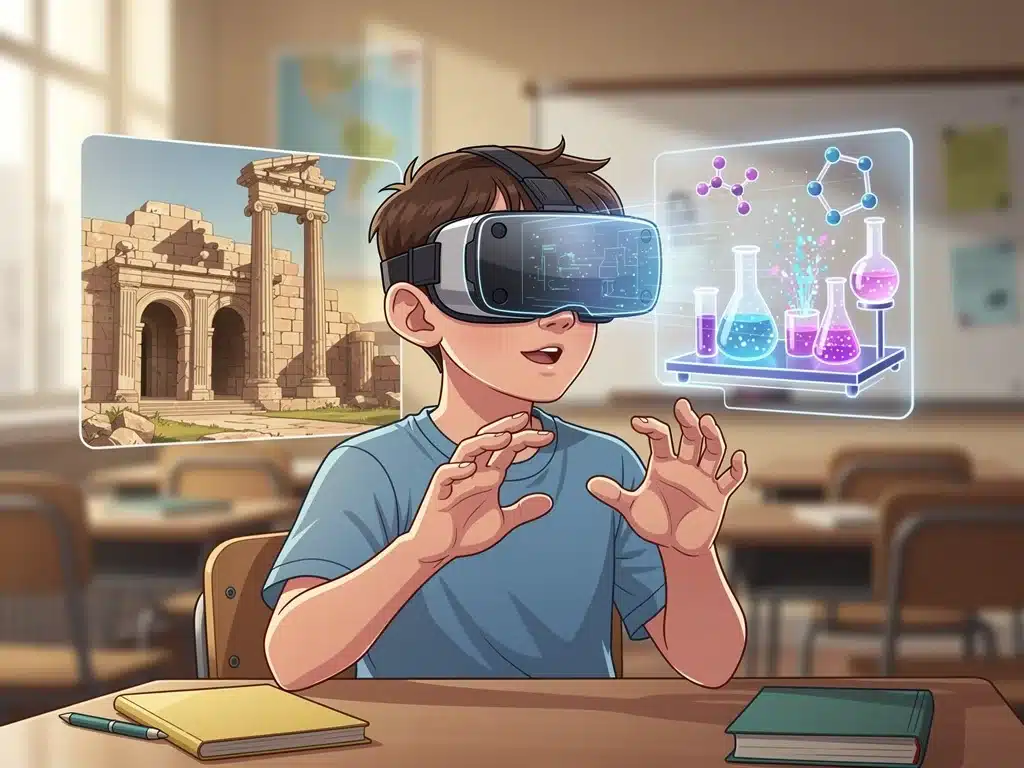
The cost of VR and AR hardware is steadily decreasing, making these technologies more accessible to a wider range of U.S. schools. Furthermore, the development of educational content for these platforms is expanding rapidly, driven by both educational institutions and tech companies. This ecosystem of hardware and software is creating a fertile ground for truly transformative learning experiences.
The immersive nature of VR and AR also has the potential to cater to different learning styles, particularly kinesthetic and visual learners who benefit from hands-on engagement. By providing multi-sensory experiences, these technologies can help solidify understanding and improve retention, making learning more effective and enjoyable for a broader spectrum of students.
Competency-based learning models
Competency-based learning (CBL) is gaining significant traction in U.S. schools as an alternative to traditional time-based progression. This model focuses on students demonstrating mastery of specific skills and knowledge areas rather than simply accumulating hours in a classroom. It represents a fundamental shift in how academic progress is measured and achieved.
Under a CBL framework, students advance once they have proven proficiency in a given subject, regardless of how long it took them to get there. This allows for both acceleration for advanced learners and additional support for those who need more time, fostering a truly individualized pace of learning. The emphasis is on deep understanding and application, not just memorization.
Measuring true mastery
The move towards CBL is driven by a desire to ensure students are genuinely prepared for college and careers, equipped with tangible skills rather than just grades on a transcript. Assessments in a CBL environment are often performance-based, requiring students to apply their knowledge in practical scenarios.
- Flexible pacing: Students can move through curriculum at their own speed, mastering concepts before advancing.
- Clear learning objectives: Competencies are clearly defined, providing transparency for students and parents about what needs to be learned.
- Meaningful feedback: Feedback focuses on specific skills and strategies for improvement, rather than just a letter grade.
One of the core benefits of CBL is its potential to reduce achievement gaps. Students who might traditionally fall behind due to a fixed pace can receive the necessary time and targeted instruction to achieve mastery. Conversely, high-achieving students are not held back, allowing them to delve deeper into subjects or move on to more advanced material.
Implementing CBL requires a significant shift in school culture, curriculum design, and assessment practices. However, the long-term benefits – including increased student engagement, deeper learning, and better preparation for future challenges – make it a compelling innovation for the future of education. It empowers students to take ownership of their learning journey.
The rise of digital citizenship and media literacy
In an increasingly digital world, the importance of digital citizenship and media literacy in U.S. schools cannot be overstated. By 2026, these will not be optional add-ons but core components of the curriculum, essential for navigating the complexities of online information and interactions responsibly and effectively.
Digital citizenship encompasses the norms of appropriate, responsible, and healthy behavior related to technology use, including online safety, privacy, and etiquette. Media literacy, on the other hand, equips students with the critical thinking skills to analyze and evaluate information from various media sources, distinguishing fact from fiction and understanding underlying biases.
Navigating the information age responsibly
With the proliferation of social media, misinformation, and cyberbullying, schools have a crucial role in preparing students to be informed, ethical, and safe digital citizens. This involves teaching them not only how to use technology but also how to use it wisely and critically.
- Online safety practices: Educating students on protecting personal information and recognizing online threats.
- Critical evaluation of sources: Teaching methods to verify information, identify bias, and understand propaganda.
- Digital footprint awareness: Helping students understand the long-term implications of their online activity.
Integrating these concepts into the curriculum means more than just a standalone unit; it involves weaving them into various subjects, from history to English to science. For instance, analyzing historical events through different media lenses can enhance media literacy, while collaborative online projects can reinforce principles of digital etiquette.
The development of digital citizenship and media literacy skills is vital for fostering a generation of informed citizens who can contribute positively to a democratic society. It prepares them not only for academic success but also for responsible participation in a world where digital interactions are increasingly commonplace and impactful.
Flexible learning environments and blended models
The traditional classroom model is undergoing a significant transformation, with U.S. schools increasingly adopting flexible learning environments and blended learning models. This innovation moves away from a one-size-fits-all approach, recognizing that different students thrive in different settings and benefit from a mix of instructional methods.
Flexible learning environments involve adaptable physical spaces that can be reconfigured to support various activities, from individual work to small group collaboration or large group instruction. Blended learning combines face-to-face instruction with online learning components, offering students more control over the pace, place, and path of their education.
Designing adaptable learning spaces
The physical layout of a classroom can profoundly impact student engagement and learning outcomes. Flexible spaces often feature movable furniture, diverse seating options, and access to technology, allowing teachers to easily transition between different pedagogical strategies throughout the day.
- Modular furniture: Desks and chairs that can be easily rearranged for group work, lectures, or individual study.
- Breakout zones: Designated areas for quiet reflection, small group discussions, or hands-on projects.
- Technology integration: Seamless access to devices, interactive whiteboards, and charging stations.
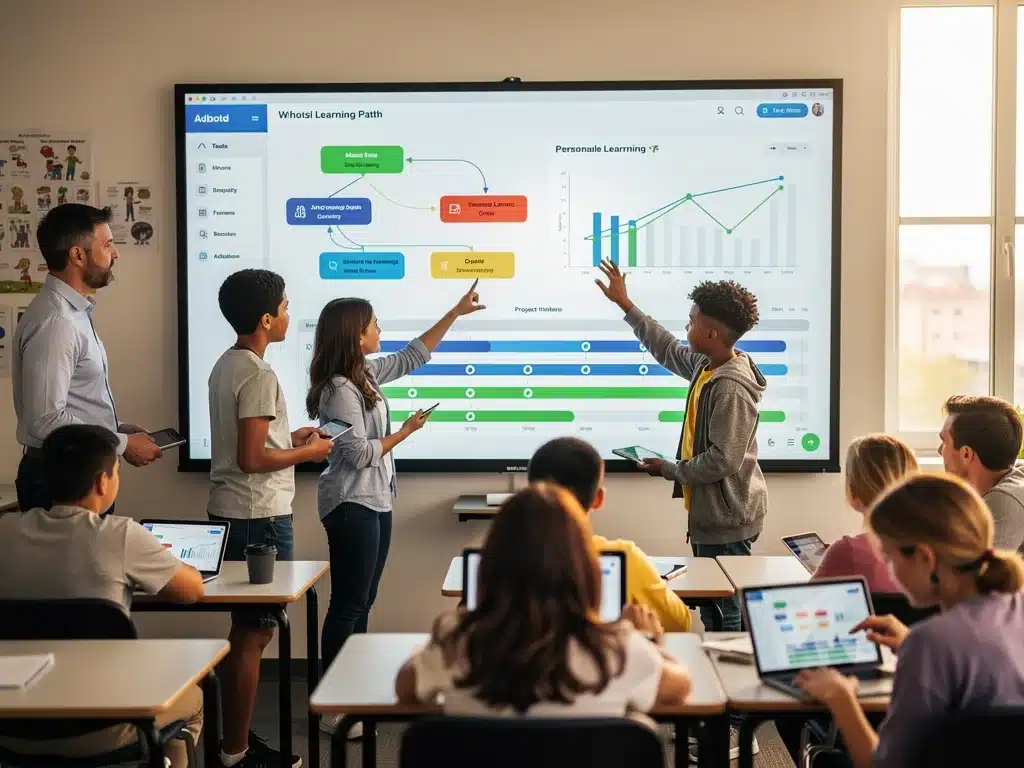
Blended learning models offer the best of both worlds, leveraging the efficiency and personalization of online resources while retaining the social and interactive benefits of in-person instruction. This approach can range from ‘flipped classrooms,’ where students learn content online at home and apply it in class, to models where students rotate between different learning stations.
The COVID-19 pandemic significantly accelerated the adoption of blended learning, demonstrating its potential for resilience and adaptability. As schools move forward, they are refining these models to create more robust and engaging learning experiences that cater to diverse student needs and prepare them for a future where adaptability is key.
Rethinking assessment and feedback mechanisms
The way U.S. schools assess student learning and provide feedback is undergoing a significant overhaul, moving beyond traditional standardized tests to more dynamic, continuous, and holistic approaches. This innovation aims to provide more meaningful insights into student progress and foster a growth mindset, aligning better with the personalized and competency-based models emerging.
Instead of relying solely on summative assessments that capture a snapshot of knowledge at a single point in time, the focus is shifting towards formative assessments that guide learning throughout the educational journey. This involves integrating technology for real-time feedback, peer assessments, and self-reflection, making assessment an integral part of the learning process rather than a separate event.
Continuous, growth-oriented evaluation
New assessment strategies emphasize understanding individual learning trajectories and providing actionable feedback that helps students understand not just what they got wrong, but why, and how to improve. This fosters a sense of agency and encourages students to view mistakes as opportunities for growth.
- Digital portfolios: Students curate examples of their best work, demonstrating growth over time and showcasing diverse skills.
- Peer and self-assessment: Students learn to critically evaluate their own work and that of their peers, developing metacognitive skills.
- AI-driven analytics: AI tools provide teachers with granular data on student performance, highlighting trends and areas needing intervention.
The shift also involves a greater emphasis on assessing 21st-century skills such as critical thinking, collaboration, creativity, and communication, which are often difficult to measure with traditional tests. Project-based learning and authentic tasks become central to these new assessment paradigms, allowing students to demonstrate these skills in real-world contexts.
Ultimately, rethinking assessment and feedback mechanisms is about creating a system that truly supports student learning and development. By providing timely, specific, and constructive feedback, and by measuring a broader range of competencies, schools can better prepare students for the complexities of higher education, careers, and life in general.
| Innovation | Brief Description |
|---|---|
| AI & Personalized Learning | Tailoring education to individual student needs using AI-driven platforms and adaptive curricula. |
| VR/AR Immersive Experiences | Using virtual and augmented reality for interactive, experiential learning across subjects. |
| Competency-Based Learning | Advancing students based on demonstrated mastery of skills, not just time spent in class. |
| Digital Citizenship & Media Literacy | Integrating critical skills for responsible and effective navigation of the digital world. |
Frequently asked questions about education’s future
AI will personalize learning by analyzing individual student data, including performance, engagement, and learning styles. It will then adapt content difficulty, recommend tailored resources, and provide real-time feedback, ensuring each student progresses at an optimal pace and receives targeted support where needed, making education highly individualized.
VR and AR offer immersive, experiential learning that transcends traditional boundaries. Benefits include virtual field trips to historical sites or distant lands, safe simulations for complex scientific experiments, and interactive 3D models that bring abstract concepts to life, significantly boosting engagement and comprehension for students across various subjects.
Competency-based learning focuses on student mastery of specific skills and knowledge rather than time spent in class or traditional letter grades. Progression occurs when a student demonstrates proficiency, allowing for flexible pacing. This contrasts with traditional grading, which often emphasizes completion and aggregate scores, potentially overlooking deep understanding.
Digital citizenship is crucial because students navigate an increasingly complex online world. It teaches responsible, ethical, and safe technology use, including online privacy, etiquette, and combating misinformation. Integrating it as a core component prepares students to be informed, critical, and respectful participants in digital society, protecting themselves and others online.
Flexible learning environments, combining adaptable physical spaces with blended online and in-person instruction, will empower students with more control over their learning. They foster greater engagement, cater to diverse learning styles, and promote collaboration and critical thinking. This adaptability prepares students for dynamic future work and social environments.
Conclusion: A new era of learning
The educational landscape in U.S. schools is on the cusp of a profound transformation by 2026, driven by these five pivotal innovations. From the personalized touch of AI to the immersive worlds of VR/AR, the mastery focus of competency-based learning, the critical skills of digital citizenship, and the adaptability of flexible learning environments, the future promises a more engaging, equitable, and effective educational journey for all students. These changes are not merely technological upgrades; they represent a fundamental rethinking of how we prepare the next generation for a world that is constantly evolving, ensuring they are equipped not just with knowledge, but with resilience, critical thinking, and a lifelong love for learning.