Augmented Reality for Kids’ Learning: 7 Platforms in 2026
Advertisements
Augmented reality is set to transform children’s education with immersive and interactive experiences; this article explores 7 innovative platforms launching in 2026 that promise to redefine learning for the next generation.
The future of education is rapidly evolving, and augmented reality for kids’ learning stands at the forefront of this transformation. Imagine a world where textbooks come alive, historical figures tell their stories in your living room, and scientific concepts are explored through interactive 3D models. This isn’t science fiction; it’s the imminent reality that augmented reality (AR) platforms are bringing to children’s education, with seven innovative platforms poised for launch in 2026, promising to reshape how young minds engage with knowledge.
Advertisements
The transformative power of augmented reality in education
Augmented reality (AR) is revolutionizing educational paradigms by seamlessly blending digital content with the real world. Unlike virtual reality, which creates entirely immersive artificial environments, AR enhances our existing reality, overlaying digital information onto our view of the physical world. For children, this means a more engaging and intuitive way to absorb complex information, fostering a deeper understanding that traditional methods often struggle to achieve.
The appeal of AR in learning stems from its ability to make abstract concepts tangible. A child can literally walk around a virtual dinosaur in their classroom or dissect a digital frog without any ethical concerns. This hands-on, experiential learning is crucial for cognitive development, as it activates multiple senses and encourages active participation rather than passive reception of information. The interactive nature of AR also caters to diverse learning styles, ensuring that visual, auditory, and kinesthetic learners can all benefit.
Beyond textbooks: immersive learning experiences
Traditional learning often relies heavily on static images and text. While foundational, these methods can sometimes fall short in capturing the imagination of young learners, especially in an age saturated with dynamic digital content. AR bridges this gap by transforming passive learning into an active exploration, making education an adventure rather than a chore.
- Enhanced visualization: Complex structures like human organs or planetary systems can be viewed in 3D, allowing for detailed examination from all angles.
- Interactive storytelling: Historical events or literary narratives can be brought to life, placing children directly within the context of the story.
- Gamified learning: Educational content is often presented as challenges or quests, boosting engagement and motivation through play.
- Real-world application: AR can simulate real-world scenarios, helping children understand how theoretical knowledge applies to practical situations.
The integration of AR into educational settings is not merely about novelty; it’s about creating a more effective and memorable learning experience. By leveraging the innate curiosity of children and providing tools that allow them to explore and discover, AR cultivates a love for learning that extends far beyond the classroom walls. This foundational shift is what makes the upcoming platforms so significant, promising to usher in a new era of interactive pedagogy.
Challenges and opportunities in AR educational development
The journey to integrate augmented reality into mainstream education is not without its hurdles. Developers face the dual challenge of creating compelling content while ensuring accessibility, affordability, and pedagogical soundness. The technology itself is evolving rapidly, demanding continuous innovation and adaptation to meet the diverse needs of learners and educators alike.
One of the primary challenges lies in content creation. Developing high-quality, educationally impactful AR experiences requires expertise in 3D modeling, animation, instructional design, and user experience. It’s not enough for an AR application to be visually appealing; it must also effectively convey learning objectives and integrate seamlessly into existing curricula. Moreover, ensuring that these platforms are intuitive for young users and manageable for educators is paramount for widespread adoption.
Bridging the digital divide and ensuring equitable access
Accessibility is another critical consideration. While AR devices are becoming more affordable, the initial investment can still be a barrier for many schools and families. Developers and policymakers must work together to ensure that these transformative tools are available to all children, regardless of their socioeconomic background. This includes exploring options for low-cost hardware, cloud-based solutions, and funding initiatives.
- Cost-effective hardware: Innovation is driving down the cost of AR glasses and tablets, making them more attainable for educational institutions.
- Curriculum integration: Platforms must offer resources and training for teachers to effectively integrate AR into their daily lessons.
- Data privacy and safety: Robust measures are needed to protect children’s data and ensure a safe, monitored learning environment.
- Teacher training: Educators need comprehensive training to leverage AR tools effectively and maximize their pedagogical potential.
Despite these challenges, the opportunities presented by AR in education are immense. The potential for personalized learning, where content adapts to each child’s pace and style, is particularly exciting. AR can provide instant feedback, track progress, and recommend tailored learning paths, making education more efficient and effective. As technology advances and development costs decrease, AR is poised to become an indispensable tool in the educator’s arsenal, fostering a new generation of engaged and knowledgeable learners.
Platform 1: ‘EduVerse Explorer’ – immersive science journeys
‘EduVerse Explorer’ is setting a new standard for science education, launching in 2026 with a promise to transport children into the heart of scientific phenomena. This platform leverages advanced augmented reality to create highly interactive and visually stunning learning modules that cover biology, chemistry, physics, and astronomy. Imagine dissecting a virtual frog with precision, exploring the molecular structure of compounds, or navigating the solar system from your living room.
The core strength of EduVerse Explorer lies in its ability to transform abstract scientific concepts into concrete, tangible experiences. Children aren’t just reading about photosynthesis; they are witnessing it unfold within a virtual plant, observing the energy conversions in real-time. This level of immersion fosters a deeper understanding and retention of complex scientific principles, moving beyond rote memorization to genuine conceptual grasp.
Interactive experiments and virtual field trips
One of the most anticipated features of EduVerse Explorer is its suite of interactive experiments. These modules allow children to conduct virtual lab experiments, manipulating variables and observing outcomes without the need for expensive equipment or hazardous chemicals. This not only democratizes access to scientific experimentation but also allows for endless repetition and exploration, encouraging a true scientific inquiry mindset.
- Virtual lab simulations: Conduct experiments on chemical reactions, biological processes, and physical laws in a safe, interactive environment.
- Planetary exploration: Take guided tours of planets, moons, and galaxies, learning about celestial bodies through interactive models.
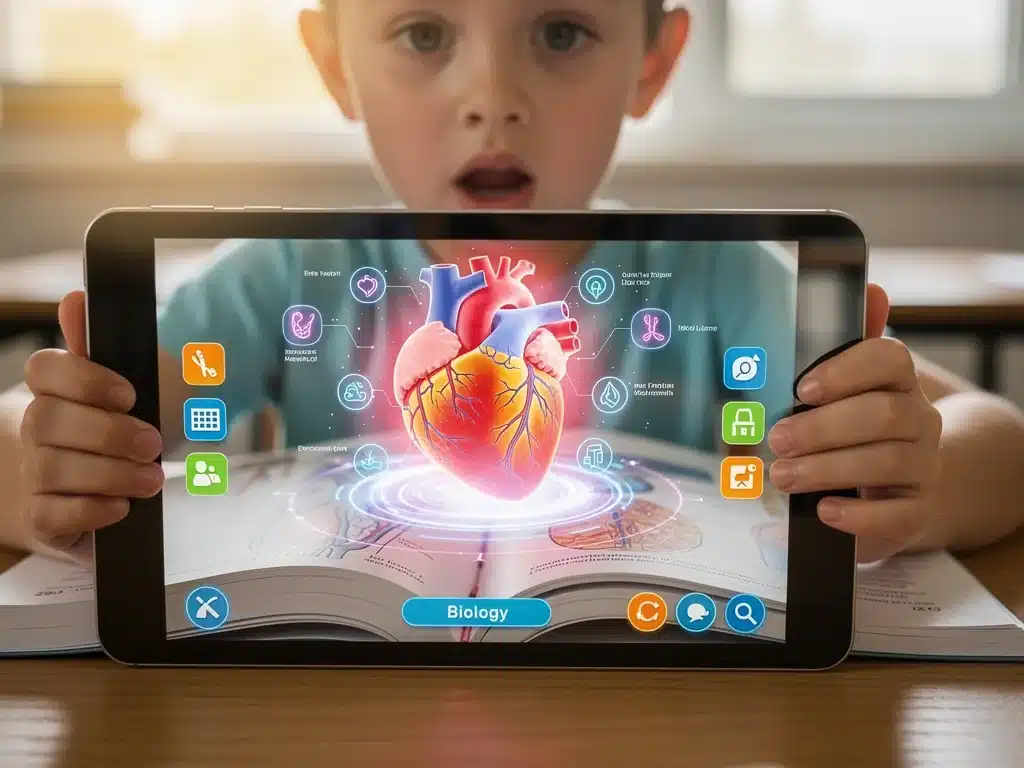
- Anatomy and physiology: Explore the human body in intricate detail, examining organs and systems in 3D.
- Ecosystem adventures: Immerse in virtual ecosystems to understand biodiversity, food chains, and environmental conservation.
EduVerse Explorer also offers virtual field trips, allowing children to visit historical scientific sites, explore natural wonders, or even journey to the microscopic world of cells. These experiences are designed to spark curiosity and inspire future scientists, making learning an exhilarating adventure rather than a classroom exercise. The platform’s intuitive interface ensures that children as young as six can navigate and interact with the content independently, making complex science accessible to all.
Platform 2: ‘StoryWeaver AR’ – bringing narratives to life
‘StoryWeaver AR’ is poised to revolutionize literacy and language arts education by transforming traditional storytelling into an interactive, augmented reality experience. Slated for a 2026 launch, this platform aims to make reading more engaging and comprehension deeper by bringing characters, settings, and plot points directly into the child’s physical space. Imagine a storybook where the characters pop out of the pages, acting out scenes right before your eyes, or historical events unfolding in a 3D panorama around you.
The platform’s innovative approach lies in its ability to bridge the gap between imagination and reality. Children can not only read about adventures but also participate in them, fostering a more profound connection with the narrative. This interactive engagement is particularly beneficial for developing empathy, critical thinking, and a love for reading, as it makes literary worlds feel incredibly real and accessible.
Interactive character engagement and creative writing tools
StoryWeaver AR allows children to interact with characters, ask them questions (through AI-powered voice recognition), and even influence certain story outcomes. This level of agency transforms passive reading into an active, decision-making process, enhancing comprehension and encouraging deeper analytical skills. The platform will feature a vast library of classic tales, modern literature, and educational non-fiction, all enhanced with AR capabilities.
- Dynamic character interactions: Engage with story characters that appear in your environment, responding to prompts and actions.
- Animated scene recreation: Watch key moments of a story unfold in 3D, bringing settings and actions to life.
- Vocabulary building games: Interactive challenges that introduce new words in context, enhancing language acquisition.
- Creative writing prompts: Tools that encourage children to create their own AR-enhanced stories, fostering imagination and narrative skills.
Beyond reading, StoryWeaver AR also includes creative writing tools that allow children to design their own AR story elements. They can create characters, build environments, and script simple interactions, thereby becoming storytellers themselves. This blend of consumption and creation empowers children to explore their literary talents, making StoryWeaver AR a comprehensive platform for fostering a lifelong appreciation for language and narrative.
Platform 3: ‘MathGami AR’ – making numbers tangible
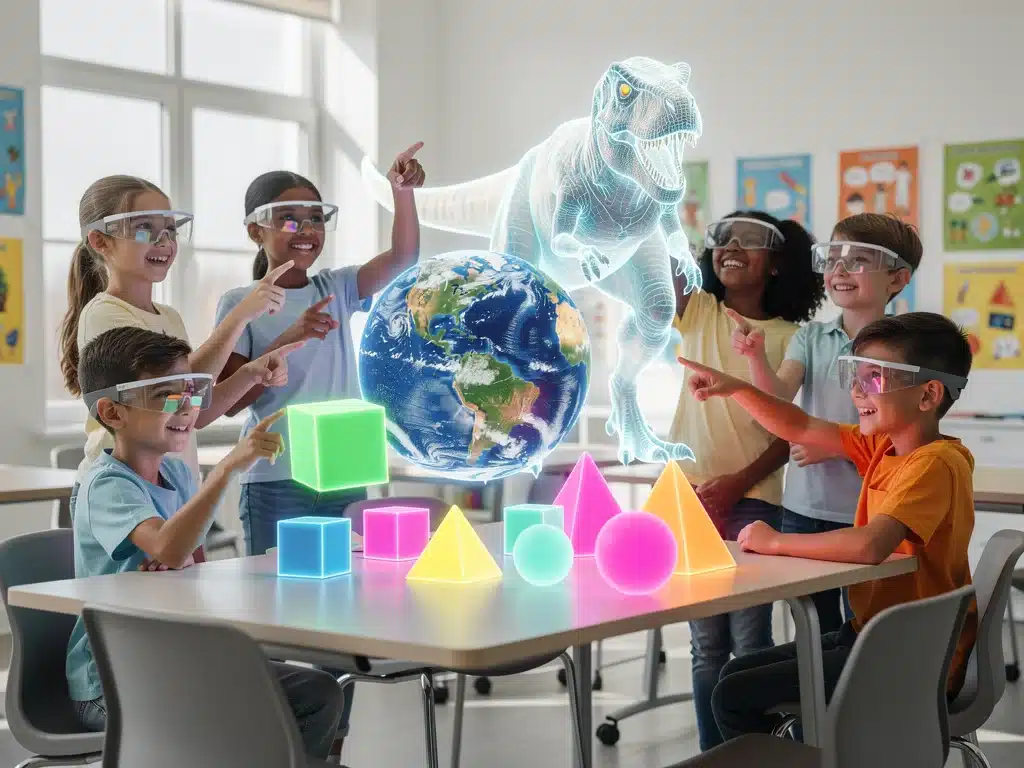
‘MathGami AR’, launching in 2026, is dedicated to demystifying mathematics for children by transforming abstract numerical concepts into interactive, manipulable augmented reality experiences. This platform aims to make math learning not just understandable but genuinely fun and engaging. Imagine solving geometry problems by physically moving and resizing 3D shapes in your room or understanding fractions by dividing virtual pizzas that appear on your table. MathGami AR brings numbers and shapes into the physical world, making them tangible and intuitive.
The platform’s strength lies in its ability to provide a visual and kinesthetic approach to mathematics. Many children struggle with math because of its abstract nature. MathGami AR overcomes this by allowing learners to interact with mathematical concepts in a concrete way, fostering a deeper conceptual understanding that goes beyond memorization. This direct engagement helps build confidence and reduces the anxiety often associated with math.
Interactive problem-solving and foundational concept building
MathGami AR offers a wide range of interactive problem-solving modules, from basic arithmetic to advanced algebra and calculus, all presented within engaging AR environments. Children can visualize mathematical relationships, experiment with different solutions, and receive instant feedback. This approach encourages exploration and discovery, turning every math problem into an exciting challenge to overcome.
- Geometry in 3D: Manipulate virtual 3D shapes to understand volume, surface area, and spatial relationships.
- Fraction and decimal visualization: Divide virtual objects to grasp concepts of parts and wholes.
- Algebraic equation solvers: Visualize equations as balanced scales, making abstract operations concrete.
- Data visualization: Create interactive charts and graphs from real-world data, understanding statistics in a dynamic way.
Furthermore, MathGami AR focuses on building strong foundational concepts. For younger learners, it introduces number recognition, counting, and basic operations through playful AR games. For older students, it tackles more complex topics like functions, probability, and even introductory coding, always maintaining an interactive and visual approach. By making math an experience rather than just a subject, MathGami AR aims to cultivate a generation of confident and proficient mathematicians.
Platform 4: ‘CodeCraft AR’ – programming for young innovators
‘CodeCraft AR,’ another pioneering platform set to launch in 2026, is designed to introduce children to the fundamentals of coding and computational thinking through an engaging augmented reality environment. This platform transforms the abstract world of programming into a tangible, interactive experience, allowing young learners to build and control virtual robots, design interactive games, and even create their own AR applications by physically placing code blocks in their surroundings. CodeCraft AR aims to demystify coding, making it accessible and exciting for the next generation of innovators.
The power of CodeCraft AR lies in its ability to provide immediate visual feedback for code. Instead of seeing lines of text, children see their commands translate directly into actions within the AR space. This direct correlation makes debugging intuitive and learning concepts like loops, conditionals, and variables much easier to grasp. It fosters logical thinking, problem-solving skills, and creativity in a way that traditional screen-based coding platforms sometimes struggle to achieve.
Building virtual worlds and interactive projects
With CodeCraft AR, children can embark on projects ranging from simple animations to complex interactive narratives. They can program virtual characters to perform tasks, design intricate pathways for robots, or even build entire virtual worlds that respond to their code. The platform utilizes a block-based coding interface, similar to Scratch, but with the added dimension of augmented reality, allowing for a more immersive and collaborative learning experience.
- Robotics simulation: Program virtual robots to navigate mazes, pick up objects, and perform sequences of actions in a real-world setting.
- Game development: Design and code simple AR games, learning about game logic, physics, and user interaction.
- Interactive storytelling: Create narratives where characters and objects respond to coded commands, bringing stories to life.
- Computational thinking challenges: Solve puzzles and challenges that require logical sequencing, pattern recognition, and algorithmic design.
CodeCraft AR also encourages collaborative learning, allowing multiple children to work on the same AR project simultaneously, seeing each other’s contributions in real-time. This promotes teamwork, communication, and shared problem-solving, essential skills for any future technologist. By making coding a playful and interactive activity, CodeCraft AR is paving the way for a generation that is not just tech-savvy but also capable of creating the technology of tomorrow.
Platform 5: ‘GeoQuest AR’ – exploring the world and beyond
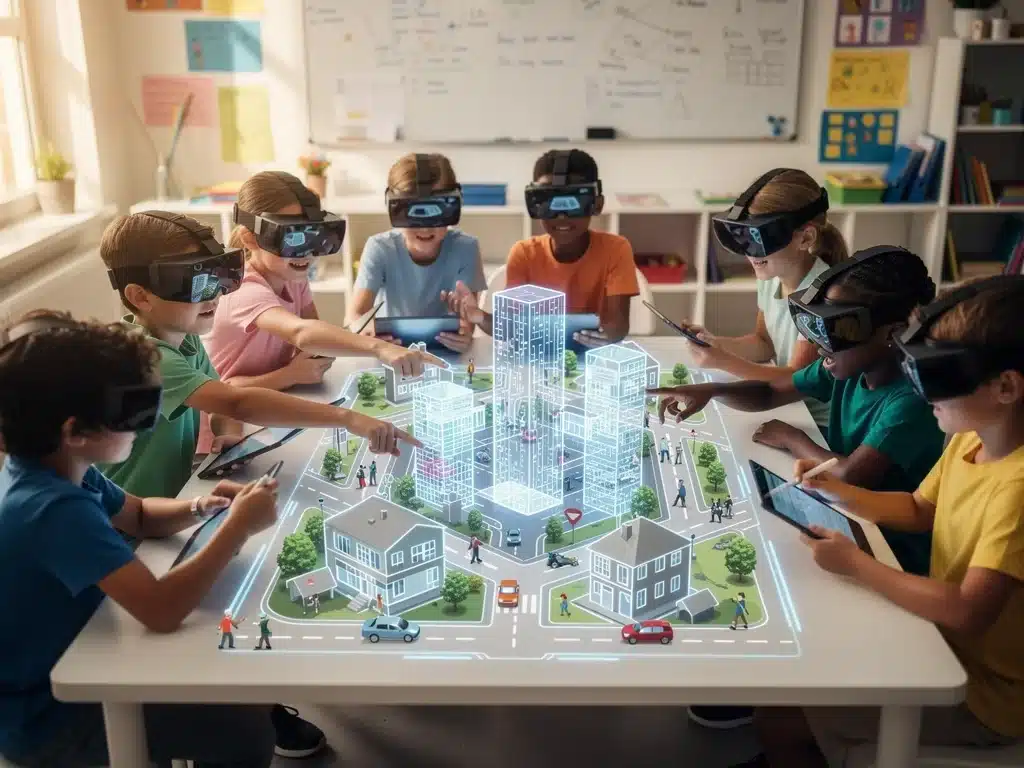
‘GeoQuest AR,’ launching in 2026, promises to transform geography and social studies education into an exhilarating global adventure. This augmented reality platform enables children to explore historical sites, ancient civilizations, diverse cultures, and natural wonders from around the globe, all from the comfort of their classroom or home. Imagine a virtual globe appearing on your desk, allowing you to zoom into any location, witness historical events unfold in 3D, or interact with cultural artifacts as if they were physically present.
The core innovation of GeoQuest AR lies in its ability to contextualize learning. Instead of merely memorizing facts about countries or historical periods, children can immerse themselves in these environments, fostering a deeper appreciation for global diversity and historical significance. This experiential learning approach makes abstract geographical and historical concepts tangible, enhancing retention and inspiring a lifelong curiosity about the world.
Interactive cultural exchanges and historical reconstructions
GeoQuest AR features interactive modules that allow children to engage with virtual historical figures, explore ancient cities as they once stood, and participate in simulated cultural exchanges. They can learn about different traditions, languages, and societal structures through direct interaction, promoting global awareness and empathy. The platform incorporates meticulously researched 3D models and historical data to ensure accuracy and authenticity.
- Ancient civilization tours: Walk through virtual reconstructions of ancient Rome, Egypt, or Mayan cities, interacting with historical elements.
- Global landmark exploration: Visit famous landmarks like the Great Wall of China or the Eiffel Tower, learning about their history and significance.
- Cultural immersion modules: Experience different cultural festivals, traditional music, and daily life scenarios from around the world.
- Environmental geography simulations: Understand climate patterns, geological formations, and ecological systems through interactive models.
Furthermore, GeoQuest AR offers dynamic map interactions, allowing children to visualize geopolitical changes, understand population distribution, and explore environmental impacts in real-time. By providing a rich, interactive tapestry of global knowledge, GeoQuest AR aims to cultivate informed and globally conscious citizens, ready to navigate an increasingly interconnected world with curiosity and understanding.
Platform 6: ‘Artistry AR’ – unleashing creative potential
‘Artistry AR,’ launching in 2026, is set to redefine how children engage with art and design, transforming their physical surroundings into a canvas for digital creativity. This augmented reality platform empowers young artists to draw, sculpt, and build in 3D space, overlaying their creations onto the real world. Imagine painting a masterpiece that floats in your living room, or constructing a virtual sculpture that interacts with your furniture. Artistry AR removes traditional barriers to artistic expression, making advanced creative tools accessible and intuitive for children.
The platform’s innovative approach lies in its ability to provide a boundless creative environment. Unlike physical art forms that are limited by materials and space, Artistry AR offers an infinite palette and an expansive digital canvas. This freedom encourages experimentation, risk-taking, and the development of unique artistic styles. It also allows children to visualize their ideas in three dimensions, enhancing spatial reasoning and design thinking skills.
Interactive design tools and virtual galleries
Artistry AR features a suite of intuitive design tools, including virtual brushes, sculpting instruments, and construction kits. Children can choose from a vast array of colors, textures, and materials to bring their visions to life. The platform supports both free-form creation and guided projects, allowing learners to follow tutorials for specific techniques or embark on their own artistic journeys.
- 3D drawing and painting: Create vibrant artworks that extend beyond flat surfaces, existing in three-dimensional space.
- Virtual sculpting: Mold and shape digital clay, learning about form, volume, and texture in an intuitive manner.
- Architectural design: Build virtual structures and landscapes, experimenting with scale, proportion, and environmental integration.
- Interactive art installations: Design art that responds to user interaction, sound, or movement, exploring principles of kinetic art.
Moreover, Artistry AR includes features for sharing and showcasing creations. Children can curate their own virtual galleries, inviting friends and family to explore their digital masterpieces. This fosters a sense of accomplishment and community, encouraging peer feedback and collaborative art projects. By democratizing access to advanced artistic tools and providing a limitless creative playground, Artistry AR is inspiring the next generation of designers, architects, and visual artists.
Platform 7: ‘EcoGuard AR’ – environmental education for future stewards
‘EcoGuard AR,’ launching in 2026, is an augmented reality platform dedicated to environmental education, designed to inspire children to become proactive stewards of our planet. This innovative platform immerses young learners in virtual ecosystems, allowing them to understand environmental challenges, observe ecological processes, and simulate conservation efforts right in their own homes or classrooms. Imagine planting a virtual tree and watching it grow over time, or cleaning up a polluted river that appears in your backyard.
The essence of EcoGuard AR lies in its ability to make abstract environmental issues tangible and personal. Climate change, biodiversity loss, and pollution often feel distant and overwhelming. EcoGuard AR brings these concepts to a relatable scale, allowing children to see the direct impact of their actions and understand the interconnectedness of natural systems. This experiential learning fosters a sense of responsibility and empowers them to envision solutions.
Simulated conservation projects and ecological interactions
With EcoGuard AR, children can engage in various simulated conservation projects. They can virtually reforest deforested areas, clean up digital oceans, or manage virtual wildlife reserves. The platform provides real-time feedback on their efforts, demonstrating the positive (or negative) consequences of their decisions. This hands-on approach to problem-solving equips children with practical knowledge and a proactive mindset towards environmental protection.
- Habitat restoration simulations: Virtually restore degraded habitats, understanding the impact of reforestation and species reintroduction.
- Pollution impact visualization: Observe the effects of plastic waste or carbon emissions on virtual ecosystems and wildlife.
- Sustainable living challenges: Participate in games that teach about renewable energy, water conservation, and waste reduction in daily life.
- Biodiversity exploration: Identify and learn about various plant and animal species within virtual biomes, understanding their roles in the ecosystem.
Moreover, EcoGuard AR features interactive modules that explain complex ecological interactions, such as food webs, nutrient cycles, and the balance of ecosystems. Children can observe how changes in one part of an ecosystem can ripple through the entire system, fostering a holistic understanding of environmental science. By making environmental education engaging, interactive, and empowering, EcoGuard AR is cultivating a generation of environmentally conscious leaders ready to tackle the ecological challenges of tomorrow.
| Platform Name | Key Educational Focus |
|---|---|
| EduVerse Explorer | Immersive science learning (biology, chemistry, physics, astronomy). |
| StoryWeaver AR | Interactive literacy and language arts, bringing stories to life. |
| MathGami AR | Tangible mathematics education, from basic arithmetic to geometry. |
| CodeCraft AR | Introduction to coding and computational thinking through AR. |
Frequently asked questions about AR for kids’ learning
Augmented reality enhances children’s learning by providing immersive, interactive experiences. It makes abstract concepts tangible, fosters deeper engagement, and caters to diverse learning styles. AR can significantly improve retention and understanding by transforming passive learning into active exploration and discovery.
AR overlays digital content onto the real world, enhancing existing reality, while VR creates entirely immersive, artificial environments. For education, AR allows children to interact with digital elements within their familiar physical surroundings, making it more accessible and less disorienting than full VR immersion.
Developers prioritize safety by implementing robust data privacy measures and age-appropriate content filters. Platforms are designed with intuitive interfaces to prevent misuse and often include parental control features. Screen time recommendations and guidance for responsible use are also typically provided to ensure well-being.
AR can enhance a wide range of subjects, including science (3D models, virtual labs), math (tangible geometry, algebra visualization), literacy (interactive storytelling), geography (virtual field trips), coding (visual programming), and art (3D creation). Its versatility makes it applicable across the entire curriculum.
Integration will involve providing comprehensive resources and training for educators, developing curriculum-aligned content, and offering flexible deployment options for various learning environments. Partnerships with educational institutions will be key to ensuring seamless adoption and maximizing the pedagogical effectiveness of AR tools in classrooms.
Conclusion
The launch of these seven innovative augmented reality platforms in 2026 marks a pivotal moment in the evolution of children’s education. From immersive science journeys with ‘EduVerse Explorer’ to creative coding with ‘CodeCraft AR,’ these technologies promise to transform learning from a passive activity into an interactive, engaging, and deeply personal experience. By making abstract concepts tangible, fostering critical thinking, and nurturing creativity, augmented reality stands poised to empower a new generation of learners, equipping them with the skills and curiosity needed to thrive in an ever-changing world. The future of education is not just about acquiring knowledge, but about experiencing it in ways previously unimaginable, and AR is leading the charge.