Finding Your Purpose: A 4-Stage Framework for Clarity

Advertisements
Discovering your life’s direction involves a structured process, and this article outlines a comprehensive 4-stage framework for finding your purpose, offering actionable steps to achieve personal clarity and sustained fulfillment.
Are you feeling adrift, seeking a deeper sense of meaning and direction in your life? Embarking on the journey of finding your purpose is a transformative experience, offering not just clarity but a profound sense of fulfillment. This article presents a practical, 4-stage framework designed to guide you through this essential process, helping you uncover your true calling and align your actions with your deepest aspirations.
Advertisements
Understanding the Quest for Purpose
The human desire for purpose is as ancient as civilization itself. From philosophical texts to modern self-help literature, the quest to understand ‘why we are here’ resonates deeply within us. Purpose isn’t merely a job title or a singular achievement; it’s an overarching sense of meaning that imbues our daily lives with significance. It’s the ‘why’ behind our actions, providing motivation, resilience, and a guidepost through life’s inevitable challenges.
Many individuals experience a period of existential questioning, particularly during significant life transitions such as career changes, empty nesting, or retirement. This is a natural and often necessary stage of personal growth, prompting a re-evaluation of values, priorities, and aspirations. Recognizing this inherent human need is the first step toward actively seeking and defining your unique purpose.
The Benefits of a Defined Purpose
Having a clear purpose extends far beyond mere intellectual understanding; it profoundly impacts various facets of life. Research consistently links a strong sense of purpose to improved mental and physical health, greater resilience, and enhanced overall well-being. It acts as an internal compass, helping individuals navigate complex decisions and stay true to their authentic selves.
- Increased Motivation: A clear purpose fuels intrinsic motivation, making it easier to overcome obstacles and pursue long-term goals.
- Enhanced Resilience: Knowing your ‘why’ provides strength during adversity, allowing you to bounce back from setbacks with greater resolve.
- Improved Well-being: Studies show a correlation between purpose and lower rates of depression, anxiety, and stress.
- Better Decision-Making: Purpose acts as a filter, simplifying choices by aligning them with your core values and long-term vision.
- Greater Fulfillment: Living a life aligned with your purpose brings a deep and lasting sense of satisfaction and contentment.
Ultimately, understanding the quest for purpose means acknowledging its fundamental role in human flourishing. It’s about recognizing that a life lived with intention is a life lived more fully, with greater joy and impact. This foundational understanding sets the stage for the practical framework we will explore, guiding you from vague desires to concrete actions.
Stage 1: Deep Self-Reflection and Introspection
The initial and arguably most crucial stage in finding your purpose involves a profound journey inward: deep self-reflection and introspection. This isn’t a superficial glance at your preferences, but a rigorous, honest examination of your inner landscape. It requires dedicated time and a willingness to confront both your strengths and vulnerabilities, your joys and your sorrows.
Think of self-reflection as peeling back layers to reveal the core of who you are. This process often involves journaling, meditation, or engaging in quiet contemplation. The goal is to identify patterns, recurring themes, and deeply held beliefs that have shaped your experiences and perceptions. It’s about becoming an observer of your own life, understanding the narratives you’ve constructed and the values that truly drive you.
Uncovering Your Core Values
Core values are the fundamental beliefs that guide your actions and decisions. They are your non-negotiables, the principles that you hold most dear. Identifying these values is paramount because your purpose will inevitably be an expression of them. If you value community, your purpose might involve bringing people together; if you value innovation, your purpose might be to create something new.
- Identify Peak Experiences: Recall moments when you felt most alive, engaged, and fulfilled. What values were being expressed in those moments?
- Analyze Low Points: Consider times when you felt frustrated or unfulfilled. What values were being violated or neglected?
- Review Role Models: Who do you admire and why? What qualities or values do they embody that resonate with you?
- Categorize and Prioritize: From your list, group similar values and then prioritize the top 3-5 that are truly non-negotiable for you.
This exercise helps to crystallize the ethical and moral compass that will guide your purpose. Without a clear understanding of your values, any purpose you define might feel hollow or inauthentic, leading to a sense of misalignment.
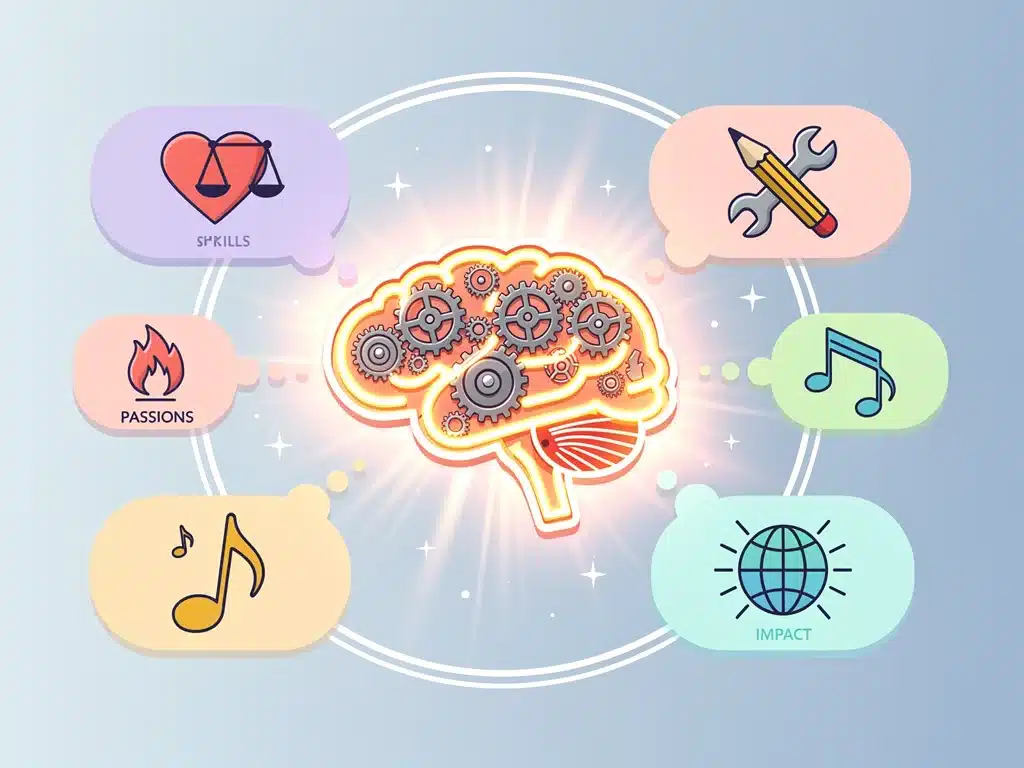
Exploring Your Passions and Talents
Beyond values, understanding your passions and natural talents provides significant clues about your purpose. What activities absorb you so completely that you lose track of time? What comes effortlessly to you, even when others struggle? These are often indicators of your innate gifts and areas where you can naturally excel and contribute.
It’s important to differentiate between fleeting interests and deep-seated passions. Passions are often accompanied by a desire to learn, grow, and improve. Talents, on the other hand, are inherent abilities that, when nurtured, can become powerful tools for making an impact. This stage encourages a playful exploration of these areas, without judgment or the pressure to immediately connect them to a ‘purposeful’ outcome.
The culmination of Stage 1 is a rich, detailed understanding of your inner world: your values, passions, talents, and the experiences that have shaped you. This foundation is essential for moving forward, providing the raw material from which your purpose will begin to emerge. It’s a continuous process, not a one-time event, requiring ongoing curiosity about oneself.
Stage 2: Connecting Your Inner World to External Needs
Once you have a clearer understanding of your inner landscape from Stage 1, the next step in finding your purpose is to look outward. Stage 2 involves connecting your deeply held values, passions, and talents with the needs and challenges of the world around you. This is where your personal meaning begins to intersect with societal impact, transforming introspection into contribution.
This stage emphasizes identifying problems or areas where your unique combination of skills and interests can make a meaningful difference. It requires observation, empathy, and a willingness to engage with issues beyond your immediate personal sphere. The goal is to find the ‘sweet spot’ where what you love to do, what you’re good at, and what the world needs converge.
Identifying Societal Gaps and Challenges
The world is full of complex problems, from environmental issues and social inequalities to educational disparities and health crises. Rather than feeling overwhelmed, this stage encourages you to view these challenges as opportunities for purpose-driven action. Which of these problems genuinely stir your emotions? Which ones do you feel particularly compelled to address, even in a small way?
- Observe Your Community: What local issues concern you? Are there specific groups or causes that resonate with your values?
- Stay Informed: Read news, documentaries, and research about global and local challenges. Pay attention to what ignites a spark within you.
- Engage in Conversations: Talk to people working in different fields, especially those dedicated to social causes. Their experiences can open your eyes to unmet needs.
- Consider Your Outrage: What injustices or inefficiencies make you genuinely angry or frustrated? Often, our outrage points to areas where we feel a strong desire for positive change.
By systematically exploring these external needs, you start to see potential avenues for applying your unique gifts. This isn’t about solving all the world’s problems, but rather identifying specific areas where your personal impact can be most potent and authentic.
Bridging Your Skills and Passions with Service
With a list of identified needs and challenges, the next step is to brainstorm how your specific talents and passions can serve these areas. This involves creative thinking and a willingness to imagine unconventional connections. For instance, if you’re passionate about art and concerned about mental health, perhaps your purpose involves art therapy for underprivileged youth.
This isn’t about finding a perfect match immediately, but rather about exploring possibilities. Consider how your unique skills, whether they are organizational, creative, analytical, or empathetic, can be leveraged to address the needs you’ve identified. Think about how your passions, even seemingly unrelated ones, could be integrated into a service-oriented role or project.
Stage 2 is about moving from internal understanding to external engagement. It’s the process of discovering where your inner strengths can meet the world’s needs, creating a powerful fusion that forms the bedrock of a meaningful purpose. This connection is vital for ensuring that your purpose is not only personally fulfilling but also contributes positively to the collective good.
Stage 3: Articulating Your Purpose Statement
Having delved into self-reflection and identified external needs, Stage 3 focuses on crystallizing your discoveries into a clear, concise, and inspiring purpose statement. This statement acts as your personal mission, a guiding principle that informs your decisions and actions. It’s not merely a descriptive phrase; it’s a declaration of your intended impact and the essence of your contribution.
Articulating your purpose requires careful thought and iterative refinement. It should resonate deeply with you, evoking a sense of truth and motivation. A well-crafted purpose statement is memorable, actionable, and provides a clear direction for your life’s journey.
Crafting an Effective Purpose Statement
An effective purpose statement is typically short, impactful, and clearly articulates your ‘why.’ It should answer the question: ‘What am I here to do, and for whom, to achieve what outcome?’ While there’s no single perfect formula, a few key elements are often present.
- Be Concise: Aim for one to two sentences that capture the core essence of your purpose.
- Be Inspiring: It should motivate you and align with your deepest values and aspirations.
- Be Action-Oriented: Use verbs that suggest active engagement and contribution, not passive states.
- Identify Your Audience/Beneficiaries: Who do you intend to serve or impact?
- State Your Desired Outcome: What positive change or result do you aim to create?
For example, instead of ‘I want to help people,’ a more powerful statement might be ‘To empower marginalized youth through education, fostering their self-reliance and creating future leaders.’ This statement is specific, outlines an audience, and defines a clear outcome.
Refining and Testing Your Statement
The first draft of your purpose statement is rarely the final one. This stage involves a process of refining, testing, and iterating until it feels truly authentic and powerful. Share it with trusted friends, mentors, or coaches to gain external perspectives, but always ensure it resonates most strongly with your inner voice.
Ask yourself: Does this statement truly reflect my core values? Does it encompass my deepest passions and talents? Does it address a need in the world that I genuinely care about? Does it feel expansive enough to grow with me, yet specific enough to guide me? The process of refinement might involve tweaking words, rephrasing sentences, or even starting anew if the initial attempts don’t quite hit the mark.
A well-articulated purpose statement becomes a powerful tool. It’s not just a collection of words, but a living declaration that you can return to repeatedly, especially during times of uncertainty or decision-making. It serves as a constant reminder of your true north, ensuring that your actions remain aligned with your overarching life’s intent. This clarity is essential for moving into the final, action-oriented stage of the framework.
Stage 4: Integrating Purpose into Daily Action
The journey of finding your purpose culminates in Stage 4: actively integrating that purpose into your daily life and making it actionable. A purpose statement, no matter how eloquently crafted, remains a theoretical concept until it is translated into concrete actions. This stage is about bridging the gap between intention and impact, transforming your clarified purpose into a living, breathing reality.
This involves identifying specific goals, habits, and projects that directly align with your purpose. It’s about consciously choosing how you spend your time, energy, and resources to manifest your purpose in tangible ways. This stage requires commitment, discipline, and a willingness to step outside your comfort zone.
Setting Purpose-Driven Goals
Once your purpose statement is clear, the next step is to break it down into actionable goals. These goals should be SMART: Specific, Measurable, Achievable, Relevant, and Time-bound. They should serve as stepping stones, each contributing to the larger realization of your purpose.
- Long-Term Goals: What major milestones do you want to achieve in the next 5-10 years that directly support your purpose?
- Mid-Term Goals: What steps can you take in the next 1-3 years to move towards your long-term goals?
- Short-Term Goals: What can you do in the next 3-6 months, or even weekly, to make progress?
- Daily Habits: Identify small, consistent actions that, over time, build momentum towards your purpose.
For example, if your purpose is ‘To empower marginalized youth through education,’ a long-term goal might be ‘Establish a non-profit educational program.’ A mid-term goal could be ‘Complete a non-profit management course,’ and a short-term goal might be ‘Volunteer 5 hours weekly at a youth center.’ Daily habits could include ‘Read articles on educational reform.’ This systematic approach ensures that your purpose isn’t just a grand idea, but a series of manageable steps.

Embracing Iteration and Adaptation
Integrating purpose into daily action is not a linear path; it’s an iterative process. You will encounter challenges, learn new information, and discover new opportunities. It’s crucial to remain flexible and willing to adapt your approach. Your purpose itself might evolve slightly as you gain more experience and insights.
This means regularly reviewing your goals, assessing your progress, and making adjustments as needed. Don’t be afraid to pivot if something isn’t working or if a new, more aligned opportunity arises. The key is to stay connected to the core essence of your purpose while being adaptable in its implementation. This dynamic approach ensures that your purpose remains relevant and continues to inspire meaningful action throughout your life.
By consistently translating your purpose into daily actions, you not only make a tangible impact but also reinforce your sense of identity and fulfillment. This final stage is where the abstract becomes concrete, and the journey of purpose truly transforms into a purposeful life.
Overcoming Obstacles on Your Purpose Journey
The path to finding your purpose and living it out is rarely without its challenges. Even with a clear framework, individuals often encounter various obstacles that can test their resolve and clarity. Recognizing these common hurdles and developing strategies to navigate them is crucial for sustained progress and fulfillment.
Obstacles can range from internal self-doubt and fear of failure to external pressures and societal expectations. It’s important to view these not as roadblocks, but as opportunities for growth and deeper commitment to your chosen path. Building resilience and a supportive network are key components of overcoming these difficulties.
Battling Self-Doubt and Fear
One of the most pervasive internal obstacles is self-doubt. The fear of not being good enough, of failing, or of making the wrong choice can paralyze even the most well-intentioned individual. This often manifests as procrastination, perfectionism, or a reluctance to take necessary risks. Overcoming self-doubt requires a conscious effort to challenge negative self-talk and cultivate self-compassion.
- Practice Self-Compassion: Treat yourself with the same kindness and understanding you would offer a friend facing similar challenges.
- Celebrate Small Wins: Acknowledge and appreciate every step forward, no matter how minor. This builds confidence and momentum.
- Seek Feedback: Constructive feedback from trusted sources can provide valuable perspective and help you refine your approach.
- Visualize Success: Regularly imagine yourself achieving your purpose-driven goals, reinforcing a positive mindset.
Remember that everyone experiences self-doubt, even those who appear most confident. The key is not to eliminate it entirely, but to learn how to act despite it, recognizing it as a natural part of any significant endeavor.
Navigating External Pressures and Expectations
Beyond internal struggles, external pressures from family, friends, or societal norms can often steer individuals away from their authentic purpose. Expectations about career paths, financial stability, or traditional life choices can create a conflict between what you feel called to do and what others expect of you. Navigating these external forces requires clear communication and strong boundaries.
It’s vital to differentiate between constructive advice and unhelpful criticism. While it’s important to listen to trusted counsel, ultimately, your purpose is deeply personal. Learning to politely but firmly assert your vision, even if it deviates from conventional paths, is a critical skill. This might involve setting boundaries around discussions, educating others about your aspirations, or finding a community that fully supports your journey.
Overcoming obstacles on your purpose journey is an ongoing process of self-awareness and strategic action. By addressing internal fears and managing external pressures, you strengthen your resolve and reinforce your commitment to a life lived with intention. Each obstacle overcome deepens your understanding of yourself and solidifies the foundation of your purpose.
Sustaining Your Purpose Over Time
Discovering and articulating your purpose is a significant achievement, but the journey doesn’t end there. Sustaining your purpose over the long term requires ongoing commitment, adaptability, and a proactive approach to nurturing your inner drive. Life is dynamic, and your purpose, while remaining constant in its core essence, may manifest in different ways as you grow and circumstances change.
This final aspect of the framework emphasizes the importance of continuous engagement with your purpose, ensuring it remains a vibrant and guiding force throughout your life. It’s about creating habits and practices that keep your purpose at the forefront of your awareness and actions.
Regular Re-evaluation and Alignment
Just as a ship needs occasional course corrections, your purpose journey benefits from regular re-evaluation. Life events, new experiences, and evolving perspectives can all influence how you perceive and enact your purpose. Periodically revisit your purpose statement and the goals you’ve set.
- Annual Review: Dedicate time each year to reflect on your purpose. Does it still resonate? Have your values shifted?
- Journaling: Maintain a journal to track your progress, challenges, and insights related to your purpose. This provides a valuable record of your evolution.
- Seek Mentorship: Engage with mentors or coaches who can offer guidance and challenge your thinking, helping you stay aligned.
- Connect with Your ‘Why’: Regularly remind yourself of the core motivation behind your purpose. What problem are you solving? What positive change are you creating?
This process of re-evaluation ensures that your purpose remains authentic and relevant to your current self and the world around you. It prevents your purpose from becoming a static declaration and instead keeps it a living, evolving guide.
Building a Supportive Ecosystem
No one thrives in isolation, especially when pursuing a meaningful purpose. Building a supportive ecosystem is vital for sustaining your drive and providing encouragement during challenging times. This ecosystem includes individuals, communities, and resources that uplift and empower your purpose-driven efforts.
Surround yourself with people who understand and believe in your vision. This could be a mastermind group, a community of like-minded individuals, or simply a few close friends and family members who offer unwavering support. A strong support system provides accountability, fresh perspectives, and emotional resilience when you need it most. It also includes actively seeking out resources, whether they are educational materials, workshops, or opportunities for collaboration, that further your purpose.
Sustaining your purpose is an active, ongoing process that combines intentional reflection with strategic action and community engagement. By continuously nurturing your connection to your purpose and building a robust support system, you can ensure that your journey remains vibrant, impactful, and deeply fulfilling for years to come.
| Key Stage | Brief Description |
|---|---|
| Stage 1: Self-Reflection | Explore core values, passions, and talents through introspection and journaling. |
| Stage 2: External Connection | Identify societal needs and connect them with your unique skills and interests. |
| Stage 3: Articulation | Craft a clear, concise, and inspiring purpose statement that guides your actions. |
| Stage 4: Daily Integration | Translate your purpose into actionable goals and consistent daily habits. |
Frequently Asked Questions About Finding Your Purpose
Finding your purpose refers to discovering an overarching sense of meaning, direction, and contribution in your life. It’s about aligning your deepest values, passions, and talents with a desire to make a positive impact, leading to sustained fulfillment and a clearer sense of why you do what you do.
While some aspects of purpose might feel like a discovery of innate leanings, it is largely a process of creation. You actively shape and define your purpose by reflecting on your experiences, choosing what matters to you, and deciding how you want to contribute to the world. It’s an ongoing, dynamic process.
There’s no set timeline for finding your purpose, as it’s a deeply personal and often iterative journey. Some individuals may have a strong sense of purpose early on, while others might spend years refining it. The key is consistent engagement with the process of self-reflection and action, rather than rushing to a definitive answer.
Yes, your purpose can evolve. While your core values might remain stable, how your purpose manifests or the specific issues you address may shift as you gain new experiences, grow as a person, or as the world’s needs change. Regular re-evaluation ensures your purpose remains authentic and relevant to your life stage.
It’s common to have multiple passions and areas of interest. Often, these can be integrated under a broader, unifying purpose. Alternatively, you might have primary and secondary purposes that you pursue concurrently or sequentially. The framework helps you identify the core thread that connects these various meaningful pursuits.
Conclusion
The journey of finding your purpose is one of the most profound and rewarding endeavors an individual can undertake. It’s a path that promises not just clarity and direction, but a deep and abiding sense of fulfillment. By systematically engaging with the 4-stage framework—deep self-reflection, connecting to external needs, articulating your purpose statement, and integrating it into daily action—you equip yourself with the tools to navigate life with intention and impact. Remember, purpose is not a destination but a continuous process of discovery, growth, and contribution, enriching not only your own life but the lives of those around you.