
How universal school meals work across states

Advertisement
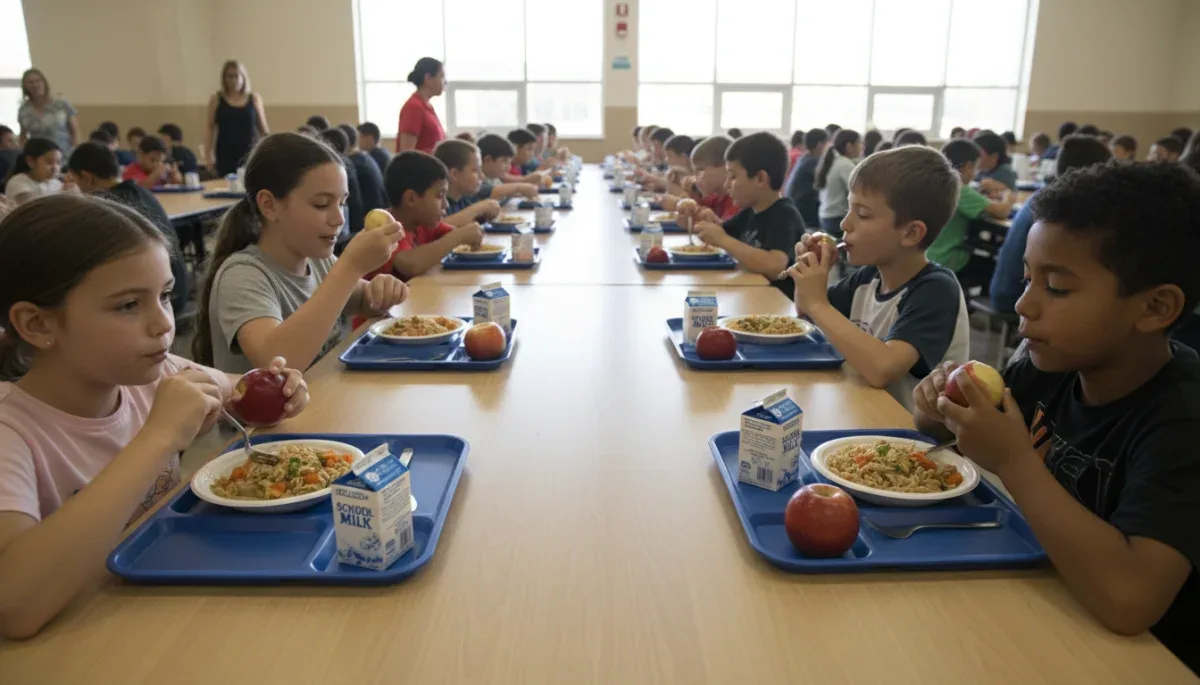
Public school universal school meals provide breakfast and lunch to every enrolled student at no cost to their household, regardless of personal income. This shift ensures children receive nutrition during the school day without administrative debt or stigma, though availability depends heavily on the state in which your school district resides.
This policy change helps working families reduce grocery expenses and eliminates cafeteria meal debt, but the catch is that programs vary significantly across state lines and still often require parents to submit income surveys to maintain local education funding.
Federal foundations and the shift to state programs
The traditional structure of American school food programs traces back to the National School Lunch Act of 1946. Overseen by the United States Department of Agriculture (USDA), public school meal funding has historically relied on a three-tier pricing structure: free meals, reduced-price meals, and full-price paid meals. Eligibility for free or reduced-price meals was tied strictly to federal poverty guidelines, requiring households to qualify through categorical programs or submit annual income verifications.
Advertisement
During the COVID-19 emergency, the federal government issued nationwide waivers that permitted every public school student to eat for free, independent of family income. When these emergency federal waivers expired at the beginning of the 2022-2023 school year, standard three-tier accounting returned across most of the country. Cafeteria lines saw an immediate return to point-of-sale transactions, meal applications, and unpaid meal balances.
Recognizing the stabilization that universal dining offered to both families and school staff, several state legislatures decided to fill the gap. Rather than allowing their districts to revert to collecting lunch money from students, these states passed targeted laws to establish permanent, statewide universal school meals. By drawing on dedicated state tax revenues, these states preserve the operational model that emerged during the emergency waiver period.
How states fund permanent meal programs
State-funded meal programs do not replace the federal child nutrition framework; instead, they operate as a supplemental layer over existing USDA reimbursements. Under these systems, schools must first maximize every available dollar from the federal National School Lunch Program and the School Breakfast Program. The state then pays the difference between the federal reimbursement rate and the actual cost of providing the meal.
Because federal reimbursement rates are much higher for students who qualify under federal poverty lines than for students in the "paid" category, state universal programs carry significant budgetary commitments. Different states have adopted distinct strategies to finance this recurring expenditure:
State legislative approaches to school meal funding
- Dedicated tax adjustments: In Colorado, voters approved Proposition FF, which capped state income tax deductions for high-income earners to create a dedicated fund for healthy school meals.
- General fund appropriations: States such as California, Maine, Minnesota, and Massachusetts use allocations from their general revenue budgets to cover cafeteria operational shortfalls.
- Surplus revenue mechanisms: Other jurisdictions rely on annual legislative budget agreements, assessing education surpluses to maintain the universal policy year over year.
Because these budgets are determined by state assemblies, the continuation of universal dining is tied directly to regional fiscal health. If state tax revenues drop or educational priorities pivot, legislatures must actively choose whether to maintain their supplemental lunch appropriations or reduce their program scope.
The Community Eligibility Provision and local mechanics
In states that have not passed universal meal legislation, many schools still offer free food to all children through a federal mechanism called the Community Eligibility Provision (CEP). Created under the Healthy, Hunger-Free Kids Act of 2010, the CEP allows high-poverty schools and districts to eliminate individual meal applications entirely.
To qualify for the CEP, a school or district must meet a designated threshold of students who are automatically approved for free meals without an application. These are known as "identified students" and include children in households participating in the Supplemental Nutrition Assistance Program (SNAP), Temporary Assistance for Needy Families (TANF), or the Food Distribution Program on Indian Reservations (FDPIR), as well as students experiencing homelessness or enrolled in foster care.
In 2023, the USDA lowered the minimum Identified Student Percentage (ISP) required for CEP participation from 40 percent to 25 percent. While this rule change dramatically expanded the number of schools eligible to adopt community-wide free meals, it did not alter the underlying federal reimbursement multiplier. Consequently, a school with a lower identified student ratio must cover the remaining costs out of local district budgets unless their state provides an overarching financial backstop.
Why paperwork still matters in universal meal states
One of the most counterintuitive aspects of universal school meals for families is the ongoing request for financial paperwork. Parents often assume that because the meals are publicly guaranteed to all students without charge, there is no need to report household earnings to the district. In reality, state and federal school funding streams remain closely linked to individual poverty data.
For decades, school districts have used free and reduced-price meal applications as the primary tool to document local poverty levels. These numbers determine how much federal Title I funding a school receives for reading specialists, math interventionists, and instructional aides. State compensatory aid formulas and local discounts—such as fee waivers for standardized tests, athletic equipment, and home broadband programs—also depend on these counts.
To protect these critical academic resources, districts in universal meal states now distribute alternative income declaration forms or "education benefit forms." While a family’s refusal to fill out the form will not stop a child from receiving a tray at lunch, low completion rates across a school can cause the district to lose significant federal classroom grants. Administrators must continually explain that the survey is no longer a lunch pass, but an assessment of educational funding needs.
Differences in menu standards and meal eligibility
Universal access policies do not alter the nutritional parameters that govern school food. Any district claiming federal or state reimbursements must serve meals that conform to the nutritional criteria of the USDA Dietary Guidelines for Americans. These rules establish minimum and maximum thresholds for calories, mandate serving sizes for fruits and vegetables, require whole-grain richness, and enforce strict limits on saturated fat and sodium.
It is equally important to understand what is included under a universal meal policy versus what still incurs a fee. The law guarantees one complete, reimbursable breakfast and one complete, reimbursable lunch per student per instructional day. A reimbursable meal requires the child to select a minimum number of components, including at least one half-cup serving of fruit or vegetable.
Items outside the standard reimbursable meal remain for-sale transactions. If a student wants a second entree, an extra carton of milk, a bottled beverage, or packaged snacks from the cafeteria a la carte line, those items must be purchased with personal funds. Families in universal meal states must still monitor cafeteria account balances if their children are allowed to purchase supplemental snacks.
Implementation challenges and cafeteria operations
The transition to universal school meals creates immediate shifts in cafeteria logistics. When cost barriers disappear, school dining participation rates increase substantially, often by twenty to forty percent within the first year. While higher participation fulfills the public goal of feeding more children, it places heavy demands on existing kitchen infrastructures that were designed for lower volumes.
Many older school buildings lack the commercial refrigeration, storage space, and prep tables needed to cook larger amounts of food from scratch. In response, food service directors often must balance increased demand against regional supply chain shortages and kitchen staffing deficits. When cafeteria teams are short-handed, districts may lean more heavily on pre-packaged, heat-and-serve items to ensure every child gets fed within the scheduled meal block.
Additionally, instructional schedules present an operational bottleneck. Most elementary and middle schools allocate only twenty to thirty minutes for lunch periods. When twice as many students line up to take a tray, time spent waiting in line reduces the time remaining to eat. School districts navigating universal dining must frequently evaluate their lunch schedules, cafeteria seating layouts, and serving point configurations to ensure students have enough time to consume their food.
At a glance
| Program component | What to know |
|---|---|
| State-level funding | State funds cover the gap between standard federal subsidies and total meal preparation costs. |
| Covered items | The program covers one complete reimbursable breakfast and lunch per student each school day. |
| A la carte purchases | Second helpings, single milk cartons, and snack items still require personal payment. |
| Household paperwork | Income surveys are still required to preserve Title I academic funding and student fee waivers. |
Frequently asked questions
Do universal school meals cover all snacks and drinks?
No, universal programs cover only one complete reimbursable meal per scheduled period. Individual milk cartons bought without a full meal, second servings of entrees, and packaged a la carte snacks still cost money and require an active cafeteria account balance.
Does a family have to opt in to receive free meals?
No formal opt-in procedure is needed in universal meal districts. Every enrolled student can walk through the cafeteria line and pick up a meal without showing cash, presenting a voucher, or providing proof of financial need at the cash register.
Why does my school still ask for our household income?
Schools use household income surveys to establish poverty percentages that determine federal Title I grants and state classroom resources. Even when meals are free to everyone, returning the form protects funding for tutors, library materials, and technology grants.
Can private schools participate in state universal meal programs?
Private school eligibility depends entirely on specific state statutes. In most states with universal meal laws, the policy applies strictly to public school districts and participating public charter institutions that follow USDA National School Lunch Program guidelines.
The bottom line
Universal school meals remove cost barriers and reduce administrative debt by serving every student balanced meals throughout the academic year. Because funding rules and program availability vary by region, parents should confirm their school district's current policy on the official district website and return all income benefit surveys promptly to support their local school.
Written by
Rita Lima
Rita Lima writes about conscious living and personal growth for portalreborn.com. Each article explains how things work, compares published details such as prices, policies and program rules, and points readers to the official source before they decide.