
Toniebox vs Yoto Player audio and features compared
Advertisement
The Toniebox is generally better suited for younger toddlers due to its durable cushioned exterior and physical figurine controls, whereas the Yoto Player offers an expansive literary library and multifunctional utility designed for school-age children. Deciding between the two platforms depends heavily on the child's developmental age, motor skills, and how your family prefers to manage digital media.
This comparison guides parents seeking an independent, screen-free listening system for home or travel, though both options require ongoing financial investment into proprietary accessories and digital catalogs to maintain interest over time.
Hardware design, durability, and daily handling
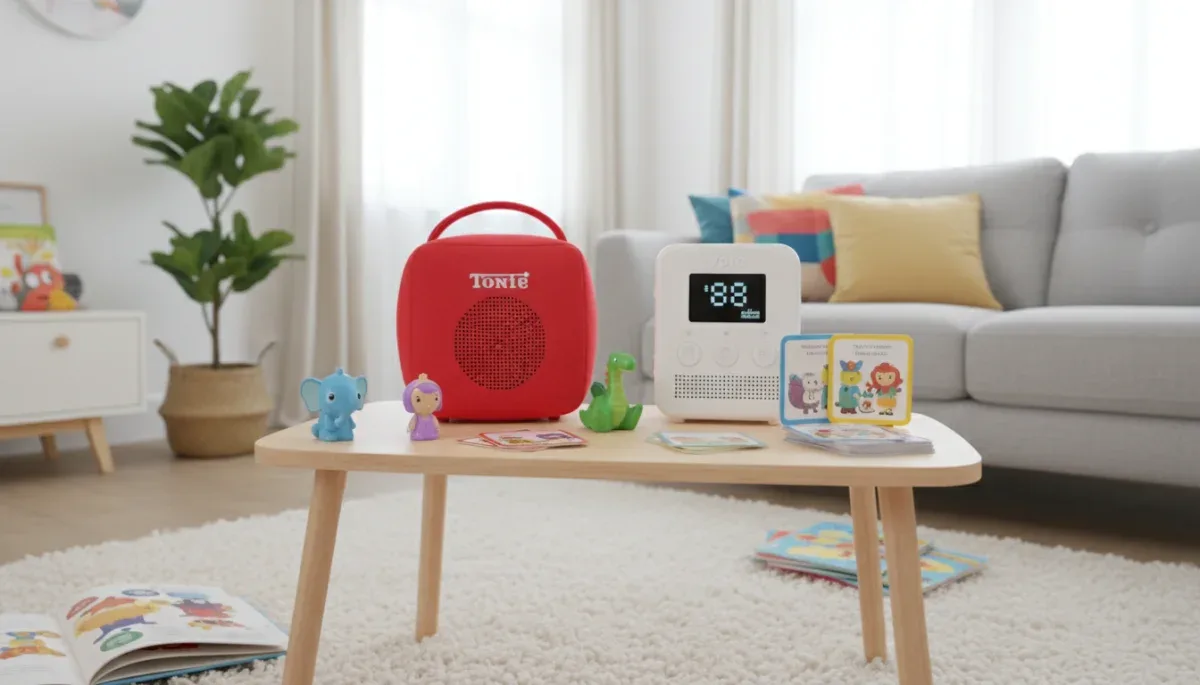
The physical construction of each audio player reflects distinctly different approaches to childhood ergonomics. The Toniebox uses a cube design wrapped in sustainable, water-repellent woven fabric over padded foam. It has no screen, no sharp edges, and no glass parts. The box is engineered to absorb drops from toddler heights and can safely be taken into bed for quiet time. Children control playback using large and small rubber ears on top of the box to adjust volume, while track skipping requires a firm slap on the padded sides of the unit. Fast-forwarding and rewinding occur by tilting the entire cube to the left or right. These physical motions appeal to sensory play and remove the need for fine motor precision, allowing children as young as age two to operate the device without adult assistance.
Advertisement
By contrast, the third-generation Yoto Player has a rigid plastic chassis shaped like an upright angled console. The front surface features a low-glare, pixel-based display that illuminates charming pixel art related to the active chapter or story. Controls consist of two tactile orange dials that turn and click to manage volume, skip tracks, and browse through chapters. While the plastic casing is sturdy, it lacks the shock-absorbing padding found on the Toniebox. Dropping a Yoto Player on hard flooring can cause cosmetic scuffs or internal damage if unprotected by an optional silicone cover. However, the Yoto Player includes multifunctional hardware elements such as an integrated nightlight that changes color, a room temperature sensor, an auxiliary headphone port, and a magnetic charging dock that doubles as a bedside clock display.
Key physical design contrasts
- Impact protection: The Toniebox features thick foam padding and stitched fabric exterior, whereas the Yoto Player relies on rigid hard plastic.
- Visual feedback: The Toniebox provides no visual display whatsoever, while the Yoto Player projects an ambient sixteen-by-sixteen pixel picture for visual context.
- Control mechanisms: The Toniebox responds to ear-pinching, tapping, and tilting, while the Yoto Player relies on turn-and-press dials.
- Bedside utility: The Yoto Player functions as a digital clock and nightlight, whereas the Toniebox remains strictly an audio speaker.
Audio libraries and available content catalogs
The content ecosystem is often the deciding factor for families, as audio media cannot be transferred between these competing platforms. The Toniebox uses hand-painted collectible figurines called Tonies. Each figurine contains an embedded radio-frequency identification chip that triggers audio playback when placed on the magnetic top pad of the box. The Toniebox catalog relies heavily on licensed preschool entertainment, including Disney classics, Sesame Street, Peppa Pig, PAW Patrol, and Julia Donaldson book adaptations. Most Tonies run between thirty and sixty minutes, offering a mixture of recognizable songs and spoken-word narration. Because the figures double as physical toys, younger children frequently incorporate them into imaginative floor play when the speaker is turned off.
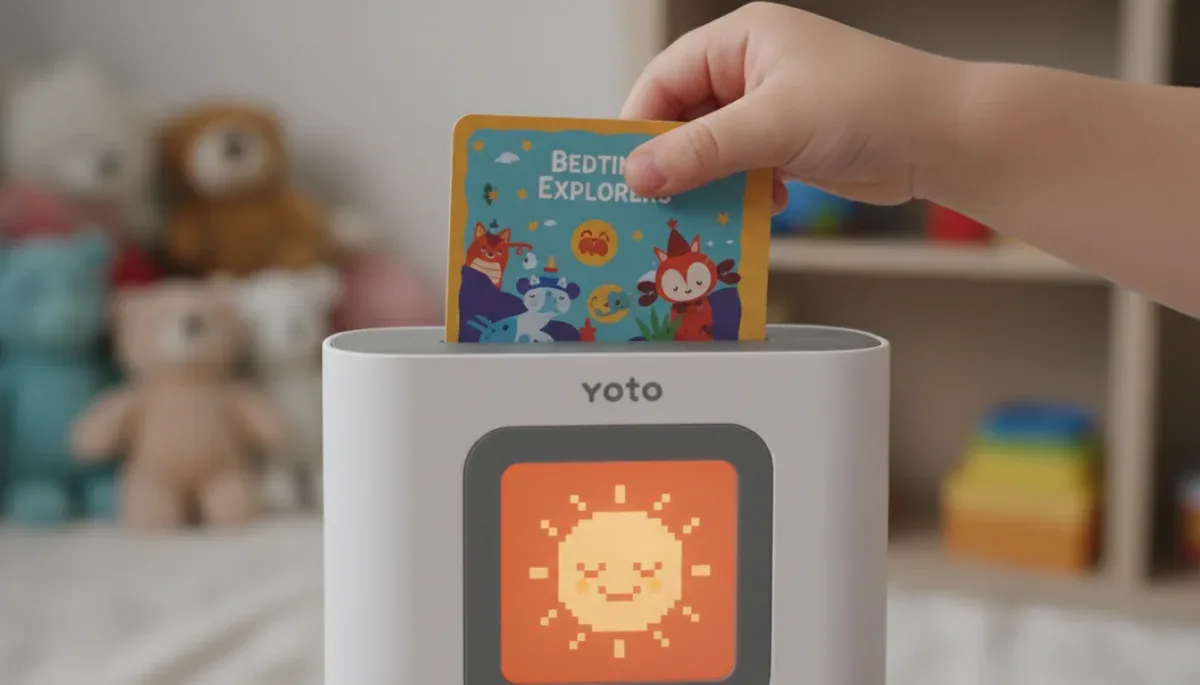
The Yoto Player utilizes sturdy, credit-card-sized smart cards that slide into a slot on top of the machine. The Yoto content library spans a significantly wider age demographic, extending from early infant white noise and nursery rhymes up to complex middle-grade literature for children aged twelve and older. Through partnerships with major publishers such as Penguin Random House and HarperCollins, Yoto offers full-length unabridged novels including the complete Harry Potter series, Roald Dahl classics, Beverly Cleary titles, and scientific audiobooks. Furthermore, Yoto provides free daily content directly over wireless internet, including the kid-friendly Yoto Daily podcast, family radio stations, and educational quizzes, delivering fresh listening material without requiring additional purchases.
Content catalog distribution
- Toniebox target audience: Best suited for ages one through six, emphasizing nursery rhymes, musical tracks, and character-driven franchise stories.
- Yoto Player target audience: Best suited for ages three through twelve, emphasizing multi-hour chapter books, educational non-fiction, and audio dramas.
- Free broadcast content: The Toniebox relies entirely on purchased figurines and occasional promotional downloads, while Yoto streams free daily podcasts and curated radio channels.
- Audio duration: Typical Tonies range from thirty to eighty minutes, while Yoto cards frequently contain between two and ten hours of unabridged text.
Make-your-own audio and custom recording features
Both manufacturers recognize that families want to hear personal recordings, family voices, and independent music playlists. The Toniebox fulfills this through Creative-Tonies, which are blank figurines capable of storing up to ninety minutes of custom audio files. Parents, relatives, or friends can use the free smartphone application or web browser portal to upload common digital audio formats such as MP3 or M4A, or record their voices directly into the app. This feature enables grandparents who live far away to read bedtime stories that play back whenever the child places that specific Creative-Tonie on the speaker. However, each Creative-Tonie is limited to that ninety-minute ceiling, requiring users to overwrite existing files to add new content.
The Yoto Player takes personal recording further with its Make Your Own card system. Families can purchase inexpensive blank cards and program them using the Yoto companion app. Each card links to a virtual playlist hosted on Yoto servers and can store up to one hundred individual tracks or five hundred megabytes of data, translating into several hours of audio per card. Users can assign custom pixel icons to each track, which illuminate on the player's front screen as the track plays. Once audio is linked, parents can rewrite the card with new content an unlimited number of times, or replace a lost physical card by linking the digital playlist to any other blank card without purchasing the content again.
Custom audio capabilities
- Storage capacity: Creative-Tonies hold up to ninety minutes, while Yoto Make Your Own cards store up to one hundred tracks or five hundred megabytes.
- Replacement workflow: Losing a Creative-Tonie means repurchasing the physical figurine, whereas lost Yoto blank cards can be instantly reassigned to digital files already in the parent app.
- Visual labeling: Tonies are easily identified by the physical figurine's appearance, while Yoto cards allow users to draw on stickers and assign pixel artwork to the digital display.
Parental controls, companion apps, and connectivity
Managing digital media without an interactive touchscreen requires robust smartphone companion software. The Toniebox application provides straightforward, essential settings. Parents can set maximum volume thresholds to protect sensitive hearing, adjust the brightness of the status indicator light, and manage household access permissions for multiple family members. The initial connection requires a 2.4 GHz wireless network. When a new Tonie is placed on the box for the first time, the device downloads the audio file completely over the local Wi-Fi connection and stores it in internal flash memory. After that initial download, the Toniebox operates entirely offline, making it impervious to internet dropouts during routine use.
The Yoto smartphone application operates as a comprehensive remote control and media manager. Parents can start audio playback, pause tracks, adjust day and night volume limits, and configure wake-to-sleep clock routines directly from their phones. The app also functions as a full mobile audio player, allowing families to stream any owned card directly through the phone's speakers or vehicle Bluetooth system even if the physical card was left behind. The Yoto Player downloads purchased card audio to its internal storage when plugged in and idle, allowing full offline functionality once caching is finished. Parents must note, however, that immediate offline play is not available for freshly purchased cards until the unit completes its background download cycle over home Wi-Fi.
Software settings and wireless management
- Volume restrictions: Both platforms let parents lock maximum volume limits via mobile settings to protect hearing health.
- Remote playback: The Yoto app can remotely trigger stories and stream owned cards on mobile devices, while the Toniebox app serves solely as an account management and recording tool.
- Offline requirements: Both devices require Wi-Fi for initial content downloads but function fully offline once audio data is stored in local flash memory.
- Headphone safety: Both systems support standard 3.5 mm auxiliary stereo headphones, with the third-generation Yoto Player also offering wireless Bluetooth headphone pairing.
Portability, battery performance, and travel readiness
Portability determines whether an audio player stays confined to the bedroom or travels along on car trips, flights, and family outings. The Toniebox has an internal rechargeable battery rated by the manufacturer for up to seven hours of continuous playback, depending on volume levels and headphone use. It charges using a proprietary circular charging station that fits neatly beneath the base. Because the device is heavily cushioned, it easily withstands being tossed into a diaper bag or vehicle backseat. The primary travel drawback is managing the physical figurines; packing half a dozen bulky figurines requires dedicated pouch space, and pieces can easily slide under vehicle seats during transit.
The standard third-generation Yoto Player offers up to twenty-four hours of battery life on a single charge and supports both proprietary wireless docks and standard USB-C charging cables, making packing for extended trips far simpler. Yoto also produces the Yoto Mini, a smaller, travel-focused alternative specifically scaled for small hands and travel bags. Regardless of which Yoto unit you use, travel storage is remarkably compact. Dozens of Yoto audio cards slide flat into compact binder sleeves or wallet cases, taking up minimal luggage space. If physical cards are misplaced on a journey, parents can continue playback through the smartphone app, an option unavailable on the figurine-dependent Toniebox system.
Pricing, ongoing investment, and total ownership costs
Screen-free audio players represent an ongoing ecosystem investment beyond the initial hardware purchase. At the time of writing, according to published manufacturer pricing, entry-level starter sets for the Toniebox typically retail around ninety-nine to one hundred dollars, which generally includes the speaker, a charging dock, and one or two introductory Tonies. Individual character Tonies generally cost between fifteen and twenty dollars each. Because an individual figurine typically holds less than an hour of audio, building a library of diverse stories and songs can add up quickly over several birthdays and holidays.
The standard third-generation Yoto Player retails around one hundred dollars, while the compact Yoto Mini sells for approximately seventy dollars at the time of writing. Individual Yoto cards range from five dollars for short story singles up to thirty or forty dollars for massive multi-card novel collections. Yoto also offers a recurring subscription service, known as Yoto Club, which delivers monthly credits for digital cards at discounted rates alongside free shipping perks. Parents should confirm current subscription fees and starter bundle prices on the official brand websites, as seasonal promotional pricing and bundled accessories change regularly.
At a glance
| Factor | What to know |
|---|---|
| Recommended ages | Toniebox focuses on ages 1-6; Yoto Player supports ages 3-12. |
| Physical durability | Toniebox features drop-resistant foam; Yoto uses hard plastic and cards. |
| Content formats | Toniebox uses collectible figurines; Yoto uses flat credit-card-sized cards. |
| Additional functions | Toniebox plays audio only; Yoto adds a nightlight, clock, and podcast stream. |
Frequently asked questions
Can both players be used without an internet connection?
Yes, both the Toniebox and Yoto Player operate fully offline after the initial setup. Each device downloads the audio file onto its internal memory the first time a figurine or card is placed on the unit while connected to Wi-Fi, allowing smooth playback anywhere thereafter.
Do these audio players require a monthly subscription to work?
No monthly subscription is required for either player. Both devices function out of the box using individual purchased cards or figurines, along with free custom recording capabilities. Yoto does offer an optional club membership for discounted card purchases, but basic operation remains entirely subscription-free.
Are both audio devices safe for toddlers to use independently?
The Toniebox is exceptionally safe and physically intuitive for toddlers as young as age two due to its soft padded exterior. The Yoto Player is safe for supervised toddlers, but its plastic construction and card slot generally suit children aged three and older better.
Can I play standard digital music files on these systems?
Yes, both brands allow you to upload personal audio files such as MP3s through their mobile applications. The Toniebox uses ninety-minute Creative-Tonies for custom audio, while the Yoto Player uses rewritable Make Your Own cards that each support up to one hundred tracks.
The bottom line
The Toniebox remains the superior option for toddlers who need an indestructible, tactile toy that withstands rough handling, while the Yoto Player is the better long-term choice for older children due to its extensive audiobook catalog, clock features, and compact card storage. Before making a final purchase, check the published content libraries on both manufacturer websites to ensure your child's favorite authors and characters are available on that specific platform.
Written by
Rita Lima
Rita Lima writes about conscious living and personal growth for portalreborn.com. Each article explains how things work, compares published details such as prices, policies and program rules, and points readers to the official source before they decide.