
Toniebox vs Yoto Player for Preschoolers
Advertisement
Choosing between the Toniebox and the Yoto Player comes down to whether your preschooler benefits more from tactile figurine play or an expanding library of audio cards with gentle visual cues. Both devices provide independent listening without screens, yet their hardware designs, navigation styles, and media ecosystems serve distinct developmental stages.
This comparison helps parents and caregivers evaluate both platforms for children ages three to five, highlighting the operational differences, setup demands, and long-term costs that accompany each system. While both brands advertise intuitive controls for young hands, the way children handle cards versus figurines shapes how they interact with stories, music, and bedtime routines.
Design, physical durability, and ease of handling
The Toniebox features a soft, padded fabric cube constructed over a shock-absorbing core, making it resilient against drops, tosses, and everyday nursery mishaps. Its exterior feels like an upholstered toy rather than consumer electronics, which appeals directly to younger preschoolers who are still developing motor control and spatial awareness. The system turns on automatically when a figurine sits on top, and volume controls are shaped like silicone ears that children squeeze directly on the device body. There are no exposed ports or delicate screens, meaning the hardware withstands rough treatment without functional damage.
Advertisement
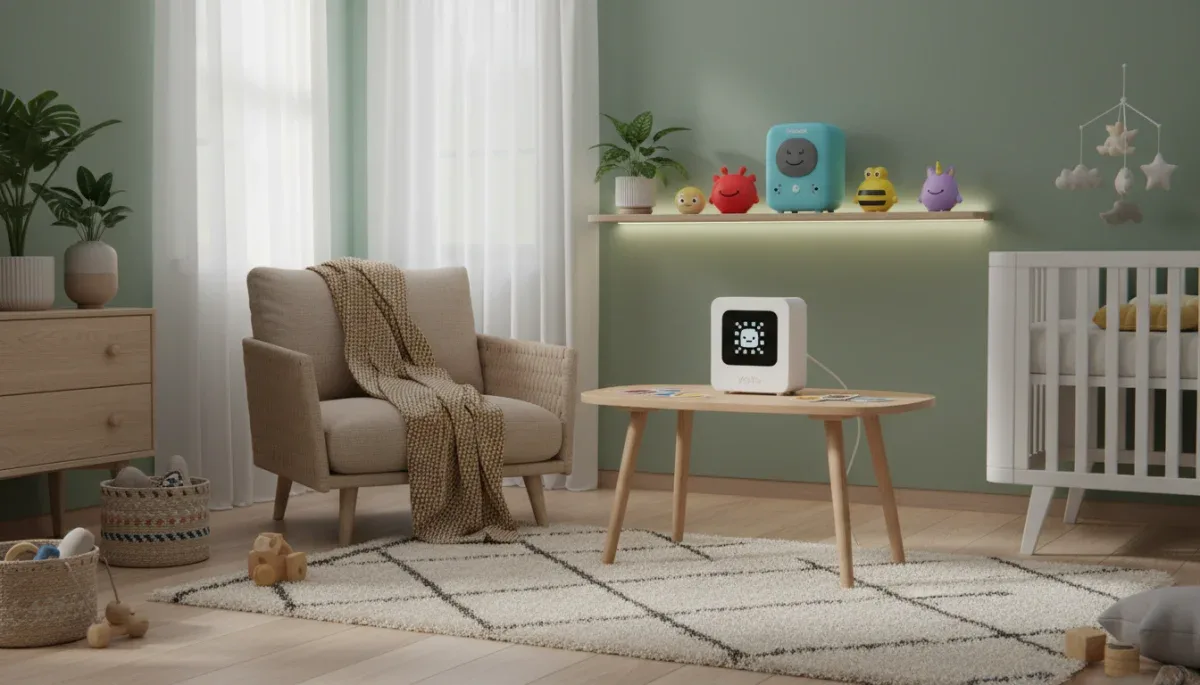
The standard Yoto Player, by contrast, adopts an upright, rigid plastic console aesthetic with an integrated pixel display on the front face. While the hard plastic shell is sturdy, it lacks the cushioned exterior of its competitor, leading many families to purchase an optional silicone jacket called an Adventure Jacket to protect against drops. The third-generation Yoto Player includes ambient nightlight features, a headphone port, and a magnetic charging dock or USB-C connection, presenting a more mature profile that fits neatly on a bedside table or bookshelf.
For children in the early preschool years, physical handling differs significantly between the two units:
- Toniebox handling: Squeezing soft ears changes volume, while firm taps on the padded sides skip tracks or rewind chapters.
- Toniebox placement: Audio begins instantly when a magnetic Tonie figurine rests upon the recessed top surface.
- Yoto Player handling: Two large, tactile orange knobs control volume and track selection with smooth rotational clicks.
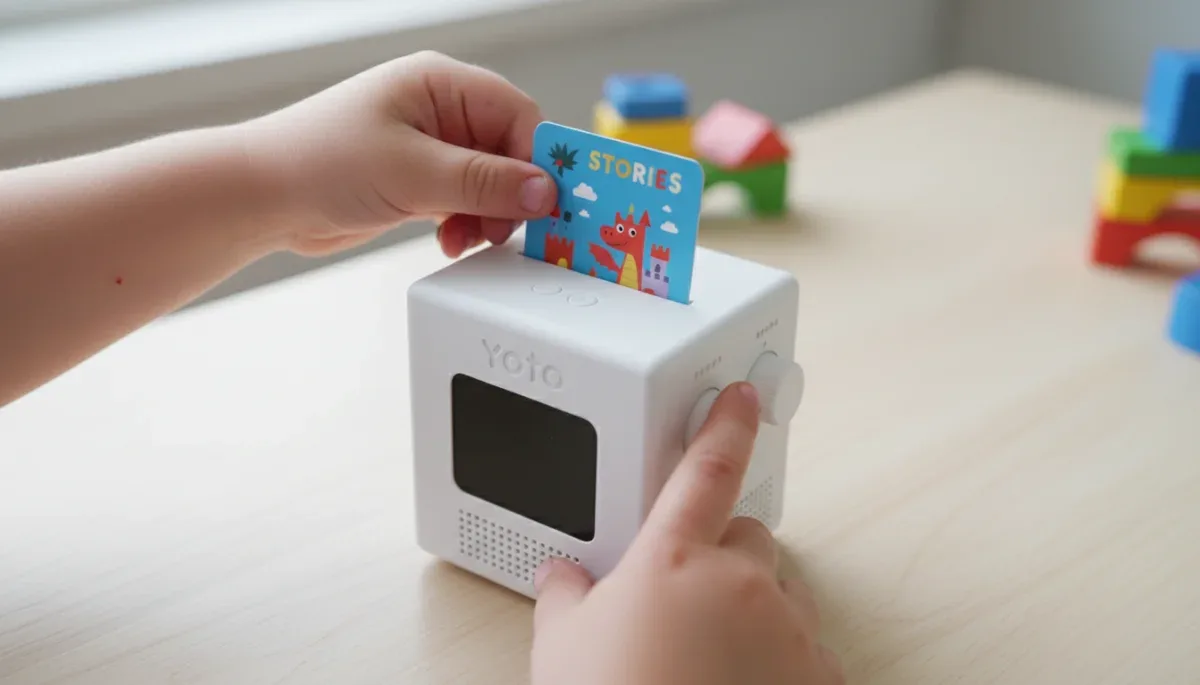
- Yoto Player insertion: Audio triggers when a durable plastic card slides into the top slot, requiring moderate hand-eye coordination.
Preschoolers who enjoy sensory play often gravitate toward the squeeze-and-tap mechanics of the Toniebox, whereas children who enjoy organizing cards or pressing functional dials adapt quickly to the Yoto interface.
How content works: figurines versus audio cards
The core distinction between these two audio players lies in how content is purchased, stored, and recognized by the hardware. The Toniebox relies on hand-painted figurines called Tonies, each containing a radio frequency identification chip that links to specific audio programs stored on company servers. Once placed on the box, the figurine downloads the audio over home Wi-Fi; after that initial download, playback happens offline without requiring a wireless connection. Children interact with these figurines as toys during playback, frequently incorporating them into imaginative games on the floor.
Yoto uses credit-card-sized plastic smart cards equipped with near-field communication chips. Swiping or sliding a card into the top slot downloads the track files directly to the internal flash memory of the player. Because the cards are flat, thin, and lightweight, they store compactly in binders, pockets, or card cases, making them simple to organize across larger collections. The front of each card displays printed cover artwork, while the digital display on the player reflects simple, glowing pixel art that corresponds to the specific chapter or song being played.
Creative and recordable options
- Creative-Tonies: Each blank figurine holds up to ninety minutes of custom audio, voice memos, or parent-uploaded audio files managed through an online portal.
- Make Your Own Yoto Cards: Blank cards allow families to link custom MP3 files, homemade voice recordings, or digital podcast feeds up to one hundred tracks per card.
- Editing flexibility: Yoto cards can be overwritten repeatedly using the companion smartphone application, whereas Creative-Tonies retain content until reassigned online.
For preschoolers who love character-based play, physical figurines offer tangible companionship. For families concerned about clutter, cards consume far less physical space and allow children to sort through dozens of stories inside a single small binder.
Content catalogs and age appropriateness
Both platforms offer extensive content selections featuring licensed entertainment brands, classic children's literature, educational tracks, and musical compilations. Tonies has established partnerships with major media companies, including Disney, Pixar, Sesame Workshop, and Universal, making familiar character voices easily accessible for younger listeners. The catalog leans heavily into early childhood favorites, nursery rhymes, lullabies, and abridged adaptations of popular animated films that resonate with toddlers and early preschoolers.
Yoto features a content library that stretches from preschool basics into middle childhood literature. Alongside Disney story cards and toddler singalongs, Yoto offers full-length unabridged audiobooks from publishers such as Roald Dahl, Beverly Cleary, and HarperCollins, as well as educational content from National Geographic Kids and specialized language lessons. The platform also streams vetted children's radio stations and a daily interactive audio program called the Yoto Daily podcast, both accessible directly from the player via Wi-Fi without inserting a card.
Because the Yoto catalog spans ages from toddlerhood through pre-teen years, the platform often remains relevant longer as a child's reading comprehension advances. The Toniebox catalog remains deeply satisfying for preschoolers seeking repetitive comfort from familiar character songs, but older siblings may outgrow the shorter adaptations and toy-centric presentation more quickly.
Battery performance, charging, and travel considerations
Portability is a central requirement for preschool audio players, as families rely on them for car rides, quiet time in unfamiliar settings, and overnight visits with relatives. The Toniebox uses an internal rechargeable nickel-metal hydride battery that provides approximately seven hours of continuous playback on a full charge. It charges via a proprietary circular charging dock that plugs into a standard wall outlet; the box simply rests on top of the base without requiring children to align small pins or insert cables.
The third-generation Yoto Player provides up to twenty-four hours of battery life on a single charge according to manufacturer specifications, making it considerably longer-lasting between wall connections. It supports both wireless charging via a proprietary magnetic dock and standard USB-C charging cables. This dual-charging capability simplifies packing for family travel, as caregivers can use standard mobile phone chargers rather than bringing a dedicated dock.
When traveling with either device, parents should consider how offline audio is managed outside the home network:
- Toniebox travel: Requires figurines to accompany the player; newly purchased Tonies must be placed on the box at home while connected to Wi-Fi before they work offline.
- Yoto Player travel: Downloaded cards function entirely offline, and parents can also play purchased card tracks directly from the Yoto smartphone app using Bluetooth if a physical card is left behind.
- Storage footprint: Multiple Tonie figurines require bulky storage bags, whereas dozens of Yoto cards fit into a compact plastic sleeve or travel pouch.
- Headphone listening: Both devices include standard 3.5 mm auxiliary headphone jacks, allowing children to listen quietly in shared spaces.
Parental controls, mobile apps, and bedtime utility
Both devices require a companion mobile application available on iOS and Android for initial Wi-Fi setup, volume limits, and profile management. Through their respective apps, parents can cap the maximum speaker volume to protect developing ears, adjust daytime and nighttime lighting, and assign content to custom recordable media. Neither platform includes a web browser, microphone for two-way communication, or third-party advertising, ensuring a closed ecosystem for young children.
The Toniebox app focuses on account administration, Creative-Tonie voice recording, and household sharing permissions. Grandparents or distant relatives can be invited to record bedtime stories directly into the app, which then sync to designated Creative-Tonies in the child's room once connected to Wi-Fi. The Toniebox automatically powers down after several minutes of inactivity, serving as a simple, passive bedtime audio companion that turns off on its own.
The Yoto application integrates deeper everyday routine tools directly into the hardware. Parents can schedule customized wake-up routines where the player's pixel display shifts between a sun and a moon to signal when it is acceptable to get out of bed. The display also doubles as an ambient digital or analog clock, room temperature monitor, and adjustable nightlight with multiple soothing colors. For sleep environments, parents can initiate white noise, pink noise, or ambient nature sounds straight from the app without inserting a physical card.
At a glance
| Feature | What to know |
|---|---|
| Primary input | Toniebox uses magnetic figurines; Yoto Player uses slim NFC cards. |
| Exterior build | Toniebox has soft padded fabric; Yoto has rigid plastic with a pixel screen. |
| Battery longevity | Toniebox runs up to seven hours; Yoto Player runs up to twenty-four hours. |
| Bedtime features | Toniebox shuts down passively; Yoto includes clock, nightlight, and sleep trainer. |
Frequently asked questions
Can either device function without an active Wi-Fi connection?
Yes, both players operate without Wi-Fi once content has been initially downloaded to the device. You must place a new Tonie on the box or insert a new Yoto card while connected to home internet first, after which the audio files play completely offline anywhere.
Are the figurines and cards safe for younger children who mouth toys?
Both brands comply with standard child safety testing requirements for ages three and older. Tonies are hand-painted figurines made from durable PVC without small detachable magnets, while Yoto cards are sturdy, waterproof plastic sheets similar to standard library cards that resist bending and chewing.
Can parents upload their own MP3 files to both platforms?
Yes, both brands provide options for custom audio files. The Toniebox uses Creative-Tonies that hold ninety minutes of audio uploaded through a web browser or app, while Yoto offers Make Your Own cards that hold up to one hundred tracks or roughly five hundred megabytes.
Which audio player is easier for a three-year-old to operate independently?
The Toniebox is generally easier for a three-year-old because placing a figurine on a flat surface requires minimal fine motor precision. Yoto cards require aligning a card into a narrow slot, which some three-year-olds master quickly while others find initially frustrating without guidance.
The bottom line
The Toniebox remains the most tactile, durable choice for young preschoolers who enjoy character toys and soft, drop-proof designs, while the Yoto Player offers longer battery life, integrated bedtime clocks, and an audio library that grows comfortably into elementary school years. Before purchasing either system, check the official websites of Tonies and Yoto to confirm current starter set bundles, regional shipping availability, and the specific titles available in their digital catalogs.
Written by
Lucas Bastos
Lucas Bastos writes about societal shifts for portalreborn.com. Each article explains how things work, compares published details such as prices, policies and program rules, and points readers to the official source before they decide.