
Timeboxing Versus Time Blocking for Daily Routines
Advertisement
Time blocking sets aside dedicated windows of time to work on specific activities, whereas timeboxing creates strict, fixed periods within which a chosen task must be finished. Choosing between timeboxing versus time blocking depends on whether your main challenge is carving out space for sustained attention or stopping tasks from expanding past reasonable boundaries. For adults juggling household duties, personal health, and remote or hybrid work, both methods replace open-ended to-do lists with calendar-based commitments, though each approaches deadlines and flexibility differently.
The primary benefit of both frameworks is that they reduce decision fatigue by establishing what needs attention before the day starts. However, rigid scheduling systems can fail when unexpected family demands, household disruptions, or shifting energy levels make an inflexible calendar impossible to maintain. Learning how each structure handles interruptions, perfectionism, and task estimation allows you to organize a personal daily routine that remains resilient when circumstances change.
The structural mechanics of time blocking
Time blocking is a planning method where you divide your waking hours into distinct, dedicated segments. Instead of keeping a running list of thirty miscellaneous chores and errands, you assign broad thematic categories or specific projects to clear blocks on a calendar. For example, rather than deciding every morning when to prepare meals, manage household paperwork, or exercise, you assign those obligations to regular slots, such as a domestic administration block from 8:00 to 9:00 in the morning or an exercise block in the late afternoon.
Advertisement
Within standard time blocking, the block represents dedicated focus rather than an absolute, immutable guarantee of task completion. If you reserve ninety minutes for deep research or sorting a family budget, your commitment is to stay focused on that work for the duration of the scheduled window. If the work remains incomplete when the block concludes, you either extend the window if your schedule permits, or schedule another block later in the week. This makes time blocking especially forgiving for open-ended, creative, or unpredictable tasks that cannot be forced into arbitrary time limits without lowering the quality of the outcome.
Key steps for setting up standard time blocks
- Identify your non-negotiable daily anchors, such as school pickup times, meals, and fixed appointments.
- Group related secondary activities into themed clusters, like domestic maintenance, administrative correspondence, or focused learning.
- Schedule larger blocks of sixty to one hundred twenty minutes for mentally demanding priorities during your peak energy hours.
- Leave open recovery blocks between scheduled periods to handle inevitable delays and family transitions.
Because time blocking focuses on allocating calendar space, it prevents overcommitment by visually showing the true physical limit of your day. Looking at an eight-hour waking span divided into discrete units quickly reveals that attempting six major household projects alongside regular caregiving and meal preparation is mathematically impossible.
The boundary-driven framework of timeboxing
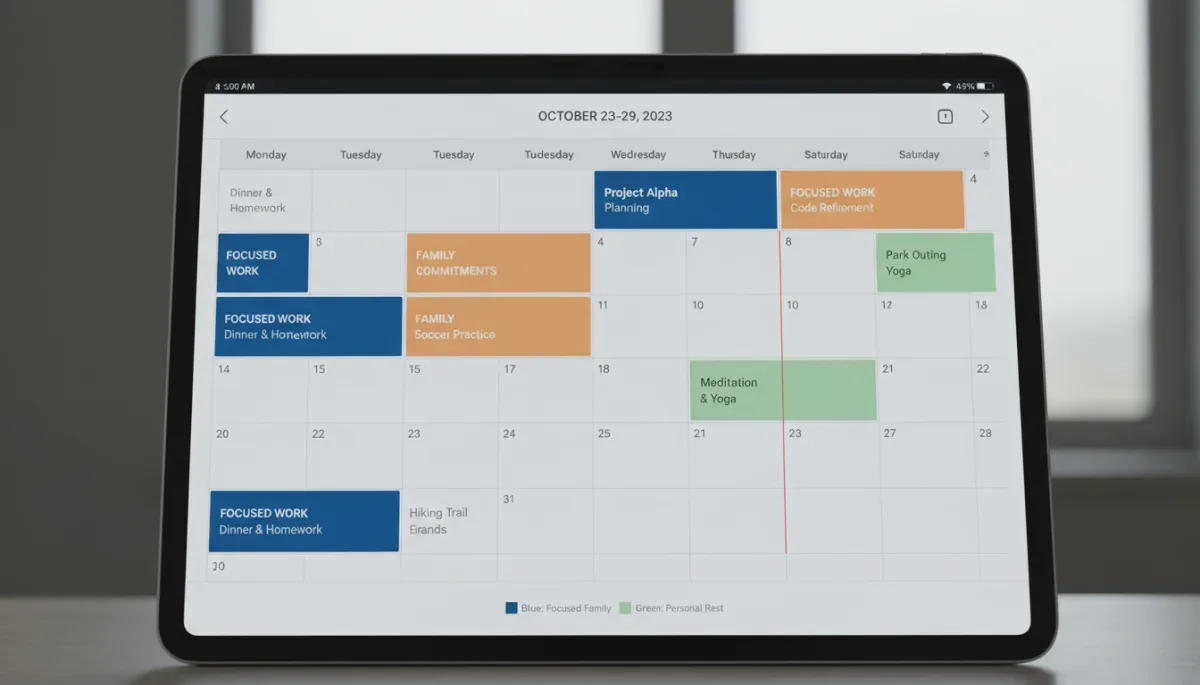
Timeboxing takes the visual scheduling element of time blocking and adds a hard, non-negotiable boundary around the output. In traditional agile project management and software engineering, a timebox is an agreed-upon limit during which a team produces the best possible result within the allocated time. When applied to personal daily routines, timeboxing means that once the timer rings or the calendar window ends, you stop working immediately, assess what you produced, and move to the next commitment regardless of whether the result is flawless.
This strict constraint serves as a direct counterweight to Parkinson's law, the well-known adage stating that work expands to fill the time available for its completion. When an errand, an email, or a home organization chore is given an open-ended afternoon block, it tends to consume the entire afternoon through unnecessary adjustments and wandering attention. By enforcing a strict forty-five-minute box on cleaning the garage or thirty minutes on sorting medical records, you force yourself to prioritize essential actions over non-essential perfectionism.
Core operating principles of an effective timebox
- Define a concrete, tangible definition of done before starting the timer to avoid scope creep.
- Treat the ending time as a firm stop rather than a flexible guideline to protect downstream commitments.
- Accept that imperfect completion is preferable to letting a single task derail your daily routine.
- Review the outcome immediately after the box closes to refine how long similar tasks take in the future.
For individuals prone to procrastination or obsessive revision, timeboxing reduces the anxiety of starting. Committing to a difficult or tedious activity becomes psychologically manageable when you know with absolute certainty that you will stop after thirty minutes, no matter what stage the task has reached.
Direct operational differences for personal schedules
While the terms timeboxing versus time blocking are often treated as synonyms in informal conversation, their behavioral impacts on your daily routine are fundamentally distinct. Time blocking is fundamentally about resource allocation: you are distributing your available hours like real estate to ensure vital priorities receive adequate attention. Timeboxing, conversely, is an accountability and efficiency mechanism designed to control pace, limit expenditure of energy, and guarantee that low-value tasks do not swallow your day.
Consider the task of organizing family tax documents or utility bills. In a time blocking framework, you might reserve two hours on Saturday morning for financial management. If the process requires searching for misplaced receipts, you stay with the task until the two hours expire, and if you are halfway through, you may choose to push lunch back thirty minutes to finish. In a timeboxing framework, you decide that sorting the receipts must fit into a single sixty-minute window. You work at a deliberate, brisk pace, eliminate unnecessary file organizing, stop at the sixty-minute mark, and file what is ready. One approach prioritizes continuity of effort; the other prioritizes strict adherence to schedule integrity.
These mechanics also alter your psychological relationship with the clock. Time blocking creates a supportive container that protects you from external distractions, inviting you to engage in sustained focus without watching every passing minute. Timeboxing introduces mild, productive urgency, encouraging decisive action and quick decision-making. Neither method is universally superior, but using the wrong one for a specific task can lead to either sluggish procrastination or unnecessary frustration.
Structuring a hybrid system for household and personal life
A functional personal routine rarely benefits from pure adherence to only one method. Everyday life involves a blend of complex, unpredictable responsibilities alongside repetitive, administrative chores. Blending both techniques into a single, cohesive daily system allows you to match the right scheduling tool to the specific nature of each responsibility.
A practical way to structure this hybrid routine is to use broad time blocks as your primary macro-schedule, and then embed specific timeboxes inside those blocks for focused execution. For instance, you might block off two hours in the morning for household operations. Rather than wandering through that block without structure, you can divide it into distinct, smaller timeboxes: twenty minutes to clear kitchen counters, twenty-five minutes to process laundry, and fifteen minutes to review weekly grocery needs. When each micro-box ends, you transition immediately, keeping momentum high and preventing any single domestic chore from dragging out.
Rules for deploying blocks and boxes together
- Use open time blocks for restorative habits, such as reading, outdoor exercise, or quality family time, where rigid timers create counterproductive stress.
- Use timeboxes for repetitive administrative chores, such as managing personal emails, clearing out clutter, or preparing simple weekly meals.
- Use time blocks for deep learning or creative pursuits where deep immersion produces better cognitive outcomes than speed.
- Reserve unassigned buffer blocks between major transitions to absorb delays caused by children, transit, or domestic emergencies.
By using blocks for lifestyle rhythms and boxes for specific outputs, your daily schedule remains organized without feeling like a rigid corporate assembly line. The macro-schedule gives your day shape, while the micro-boxes provide the engine that moves tasks across the finish line.
Managing common implementation obstacles
The most frequent reason people abandon calendar-based routines is chronic underestimation of time. Human beings consistently display an optimism bias when predicting how long a chore or appointment will take. When an individual schedules back-to-back sixty-minute blocks with zero margin for error, a single late delivery, phone call, or misplaced set of keys cascades into the entire afternoon, causing the system to collapse under its own weight.
To insulate your calendar from collapse, build white space directly into your day. White space is deliberate, unscheduled time that serves as a shock absorber for ordinary daily friction. For every four hours of planned blocks or boxes, an adult running a household should consider leaving thirty to sixty minutes completely empty. If the morning runs smoothly, that buffer time becomes an opportunity for rest, a brief walk, or early preparation for the evening. If disruptions occur, the buffer absorbs the delay without displacing vital commitments or personal downtime.
Another persistent obstacle is calendar fatigue. When every fifteen-minute increment of a day is filled with brightly colored calendar events, the visual complexity can feel exhausting before the day even begins. If your routine feels overwhelming, zoom out: eliminate micro-blocks and replace them with two or three simple, primary focus periods per day. A schedule should serve as an enabling tool that supports your energy, not an exacting master that creates continuous feelings of failure.
Tool selection: digital calendars versus paper agendas
Executing time blocking and timeboxing requires choosing an interface that fits your working environment and lifestyle. Digital calendar applications, such as Google Calendar, Apple Calendar, and Microsoft Outlook, provide powerful structural advantages for time management. They allow you to set recurring blocks, drag and drop scheduled segments when your day shifts, and configure notifications that alert you five minutes before a timebox closes.
Digital tools also allow for shared visibility. In a family setting, maintaining a shared calendar block for shared domestic tasks or childcare coverage ensures that all partners operate from the same baseline information. Color-coding different categories—such as personal health in green, administrative chores in blue, and family obligations in yellow—gives you an immediate, high-level picture of your balance over the course of an entire week.
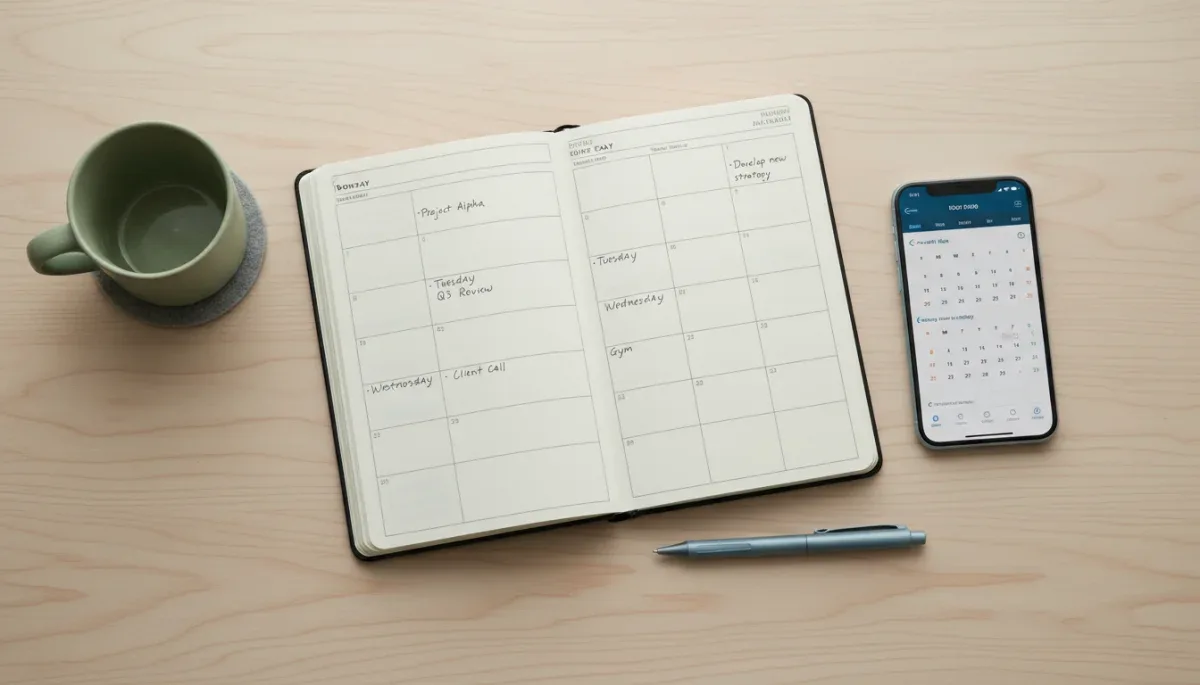
Paper planners and physical day sheets offer an alternative that eliminates digital distractions. Writing down your blocks by hand each morning requires an active, physical engagement that reinforces intentionality. When working within a paper framework, using an analog kitchen timer or a standalone desk clock often works better than using a smartphone timer, as looking at a phone screen invites notifications and social media distractions. If you struggle with screen addiction or digital overload, keeping your personal daily routine on paper provides clarity without the temptation of incoming digital alerts.
At a glance
| Planning factor | What to know |
|---|---|
| Primary purpose | Time blocking reserves focus periods, while timeboxing caps task duration. |
| Handling perfectionism | Timeboxing stops excessive tweaking by enforcing a firm cutoff point. |
| Schedule flexibility | Time blocking adjusts easily, while timeboxing demands strict boundary adherence. |
| Best daily role | Use blocks for deep personal focus and boxes for routine maintenance chores. |
Frequently asked questions
Can I use both methods within the same day?
Yes, combining both methods is often the most effective approach for personal routines. You can establish broad time blocks for general categories like household administration or deep work, and then set tight timeboxes within those blocks to ensure specific chores are completed briskly without overrunning the schedule.
What should I do if a task is not finished when the timebox ends?
Stop immediately and evaluate your progress. If the outcome meets baseline requirements, mark it complete; if it truly requires more work, schedule a new, separate timebox on another day rather than letting the current task spill into downstream personal commitments.
How do I handle unpredictable interruptions from family members?
Build deliberate buffer blocks of unscheduled time between your major commitments to absorb everyday domestic interruptions. If an unexpected obligation arises, shift your remaining blocks rather than abandoning your entire structure, and communicate your quiet focus periods clearly to household members in advance.
Which technique is more effective for combating chronic procrastination?
Timeboxing is generally more effective for overcoming procrastination because it lowers psychological resistance. Committing to a hard stop after fifteen or twenty minutes makes starting an intimidating chore feel manageable, whereas open-ended time blocks can sometimes feel too long and mentally draining to begin.
The bottom line
Time blocking secures time for your most meaningful personal priorities, while timeboxing prevents routine tasks from draining your day through endless perfectionism. Most sustainable daily routines thrive when these two techniques work in harmony: broad blocks provide predictable structure, while focused boxes drive efficient completion. Before you restructure your upcoming week, look closely at your actual historical energy patterns and choose one single recurring friction point to test under these frameworks rather than overhauling your entire calendar overnight.
Written by
Maria Eduarda
Maria Eduarda writes about tech & life, gift guides and seasonal toys for portalreborn.com. Each article explains how things work, compares published details such as prices, policies and program rules, and points readers to the official source before they decide.