
Rain barrel installation rules: what to check first
Advertisement
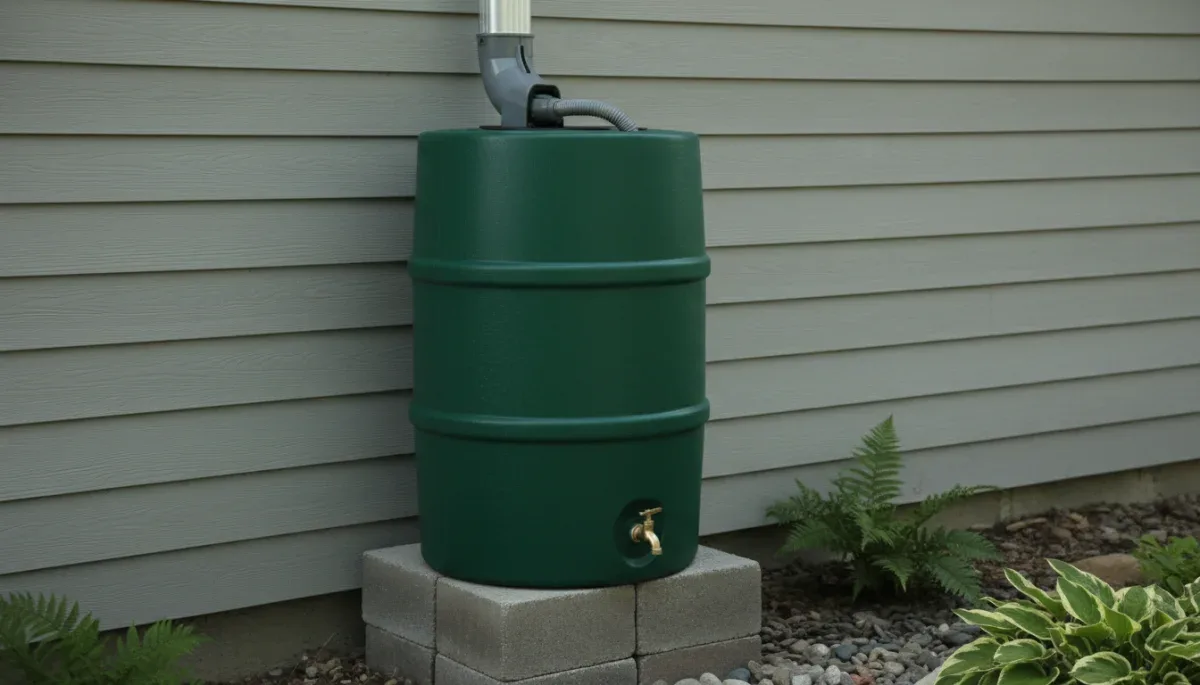
Homeowners installing a rain barrel must verify state water rights laws, municipal building codes, and homeowner association covenants before connecting any container to a downspout. While capturing roof runoff is encouraged across most regions to conserve water, various jurisdictions place strict limits on storage volume, system design, and placement.
Setting up a rainwater catchment system helps reduce municipal utility reliance for lawns and flower beds, but skipping the initial regulatory and structural checks can lead to code enforcement fines, foundation subsidence, or public health violations. Taking time to review property restrictions, structural requirements, and mosquito prevention guidelines ensures your system functions safely, sustainably, and in full compliance with local authorities.
State water rights and statutory collection limits
In the United States, rainwater collection legality depends heavily on whether your state operates under riparian water rights or the prior appropriation doctrine. Western states historically restricted rainwater capture because precipitation was legally tied to downstream senior water rights holders. Although absolute bans have largely been replaced with permissive legislation, specific statutory boundaries remain in effect.
Advertisement
In Colorado, for example, residential precipitation collection is regulated under House Bill 16-1005. The law permits residential property owners to install up to two rain barrels with a combined maximum capacity of 110 gallons. The collected water must be used exclusively for outdoor applications on the property where it was gathered, such as watering a lawn or garden, and cannot be used for indoor plumbing or drinking water. In Utah, state statute allows individuals to collect up to 100 gallons of rainwater without registering, but systems capturing up to 2,500 gallons require formal, free registration with the Utah Division of Water Rights.
Conversely, many eastern, central, and southern states actively incentivize rainwater harvesting. Texas, for instance, provides property tax exemptions for commercial water conservation systems and offers statutory protections for residential collection. However, even in permissive states, statutory thresholds can change. Always consult your state department of natural resources, state engineer office, or department of environmental protection website to confirm current gallon thresholds and registration procedures before buying hardware.
Municipal codes, permits, and utility requirements
Beyond broad state laws, city and county building departments enforce residential plumbing and building standards that directly govern how water barrels connect to structures. Many municipalities adopt model standards such as the International Plumbing Code or the Uniform Plumbing Code, which dictate how non-potable water systems must interact with residential plumbing and drainage networks.
Standard gravity-fed rain barrels that sit outdoors and feed a garden hose rarely trigger formal building permit requirements. However, you will likely need a plumbing permit and professional inspection if you plan to install an automated booster pump, connect the barrel to an in-ground drip irrigation manifold, or route captured water into a dwelling for toilet flushing or laundry. Municipalities require certified backflow prevention devices on any system physically tied to indoor plumbing or municipal drinking water lines to eliminate the risk of non-potable roof runoff siphoning back into the public supply.
Some local utilities also offer rebate programs that offset the purchase price of certified rain barrels. These financial incentives often come with binding technical stipulations. To qualify for a rebate, the utility may require you to install an enclosed barrel equipped with a pre-drilled overflow port, a sealed lid, and an integrated debris screen. Check with your local water authority to determine whether rebate applications require pre-approval or post-installation photographic proof.
Homeowner association rules and architectural guidelines
If you live in a planned development, subdivision, or condominium community governed by a homeowner association (HOA), you must review the community covenants, conditions, and restrictions (CC&Rs) prior to installation. HOAs frequently maintain strict visual standards designed to preserve neighborhood cohesion, and visible utility barrels placed along front or side elevations are a frequent source of compliance disputes.
Common architectural restrictions for residential barrels
- Mandatory rear-yard placement so containers remain invisible from the common street.
- Requirements to paint or clad barrels to match the existing exterior siding or trim color of the home.
- Installation of evergreen vegetative screening, wooden trellises, or decorative privacy fences around collection equipment.
- Restrictions against using recycled industrial drums in favor of commercially manufactured, earth-tone rain containers.
State laws increasingly protect water-saving initiatives from outright association bans. Statutes in states like California, Texas, and Florida forbid associations from completely barring homeowners from installing rainwater collection systems. Nevertheless, these statutes generally allow HOAs to enforce reasonable architectural controls regarding placement, aesthetic screening, and barrel dimensions, provided those guidelines do not substantially increase system cost or impair operating efficiency. Always submit an architectural review application with product dimensions and site drawings if your community bylaws require prior approval.
Structural support and foundation safety
One of the most dangerous oversights in DIY rainwater collection is failing to build a stable, level foundation. Water is exceptionally dense, weighing approximately 8.34 pounds per gallon. A standard 55-gallon rain barrel weighs more than 450 pounds when fully charged, while larger multi-barrel configurations or 200-gallon cisterns can easily exceed three-quarters of a ton. Placing that much weight on uncompacted soil or unstable supports invites severe structural failure.
Never balance a heavy water container on bare dirt, sloping turf, or hollow concrete masonry blocks positioned with their cavities facing sideways. Hollow cinder blocks are engineered for compressive strength only when oriented vertically; when turned on their sides, the thin outer webs can shear and crumble without warning under sustained weight. A collapsed barrel can crack siding, tear downspouts away from roof eaves, cause significant flooding against the exterior wall, or inflict serious crushing injuries on family members or pets.
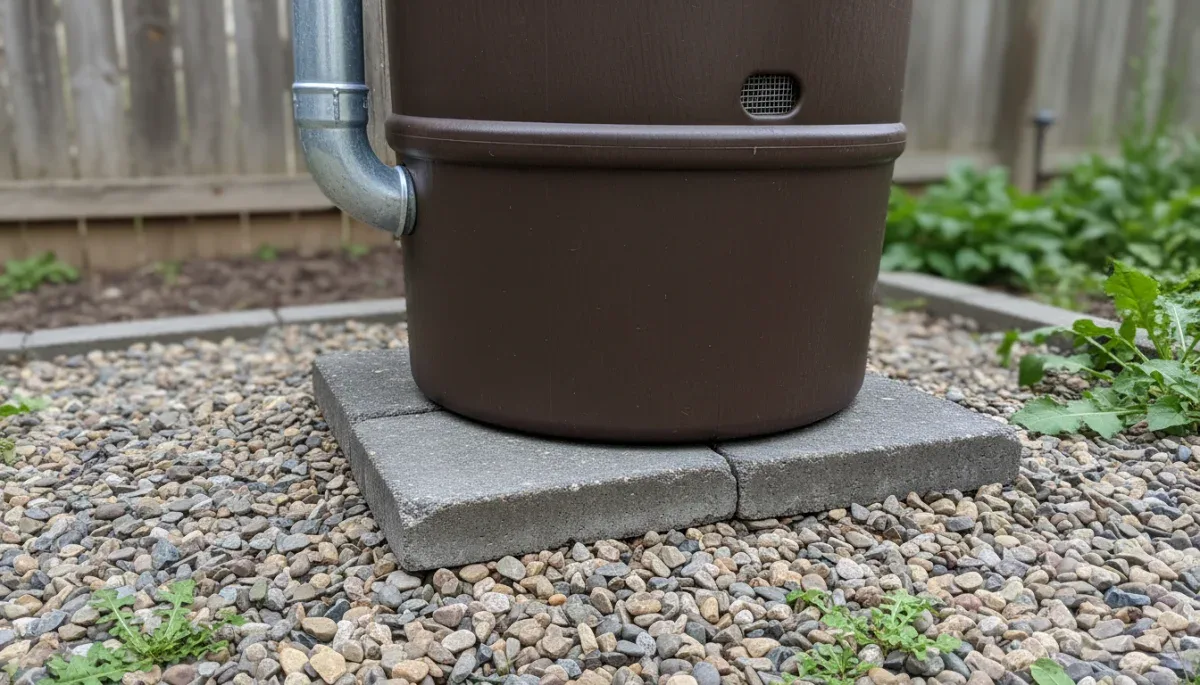
To establish a safe foundation, excavate the soil adjacent to your downspout down to stable subsoil, removing turf, roots, and organic matter. Backfill the excavation with two to three inches of crushed gravel or crushed limestone, compacting it firmly with a hand tamper until solid and plumb. Place solid concrete pavers or heavy-duty stone slabs directly over the gravel base, checking alignment with a bubble level in both directions. Raising the barrel between twelve and eighteen inches on solid pavers not only ensures structural integrity but also generates the hydrostatic pressure needed to fill watering cans or run a short garden hose efficiently.
Overflow routing and foundation protection
Managing the volume of water your roof generates during a typical storm is critical for preventing basement water intrusion and foundation damage. Many homeowners underestimate the volume of water produced by rainfall. A 1,000-square-foot roof section produces approximately 620 gallons of water from a single inch of rain. Because a typical 55-gallon container captures only a small fraction of that runoff, the barrel will reach full capacity within minutes of a standard rainfall event.
Without an engineered overflow plan, excess water will spill over the top rim of the barrel, pooling directly against the foundation walls of your house. Concentrated saturation against concrete footings can degrade exterior waterproofing, cause basement seepage, destabilize perimeter soils, and trigger foundation settlement. Therefore, an active overflow protocol must be established as part of the initial installation.
Effective strategies for managing system overflow
- Installing an automatic downspout diverter that directs water into the barrel until full, then naturally routes excess water back down the main gutter pipe.
- Attaching a smooth, non-kinking overflow discharge hose measuring at least one and a half inches in diameter to the barrel upper port.
- Directing the discharge hose at least six to ten feet away from the home foundation toward a vegetated swale, rain garden, or designated storm drain.
- Linking multiple containers together via bottom or top balance lines to expand surge capacity during prolonged downpours.
Ensure that the discharge outlet discharges onto a gently sloping surface that leads away from adjoining properties. Discharging concentrated roof runoff across property lines onto an adjacent lawn or driveway can violate municipal surface water nuisance ordinances and generate civil liability.
Mosquito prevention and water quality safety
Standing water in residential yards creates ideal breeding habitat for disease-transmitting insects, particularly mosquitoes in the Culex genus, which can transmit West Nile virus. Municipal health departments frequently cite homeowners and issue abatement notices for unmaintained water containers that lack proper screening or vector controls.
A female mosquito requires less than an inch of stagnant water and roughly seven to ten days to complete its reproductive life cycle from egg to adult. Every opening on your rain barrel, including the top downspout inlet, the overflow port, and any secondary vent holes, must be sealed with corrosion-resistant insect mesh featuring openings of 1/16th of an inch or smaller. Ensure that barrel lids feature tight-fitting gaskets and that spigot connections are sealed with thread tape to eliminate standing pools on external seams.
Beyond insect concerns, water quality dictates how you should safely use collected roof runoff. Rainwater collected from conventional asphalt shingle roofs carries atmospheric particulates, bird droppings, mold spores, and trace heavy metals leached from shingle granules. Consequently, harvested rainwater is classified as non-potable. Never use untreated rain barrel water for drinking, cooking, bathing, or pet consumption.
When applying water to home gardens, avoid spraying roof water directly onto the harvestable foliage of leafy greens, root vegetables, or soft-skinned berries. Instead, apply the water directly to the surrounding soil via low-pressure drip lines or a watering can, keeping edible crops clean. If your home has an older roof constructed with copper flashing, treated cedar shakes, or lead-containing soldered valley seams, reserve your collected water strictly for ornamental lawns, shrub beds, and non-edible landscaping.
At a glance
| Factor | What to know |
|---|---|
| State water laws | Specific states enforce strict storage volume caps and outdoor-use restrictions under statutory water rights frameworks. |
| Foundation stability | A full 55-gallon container weighs over 450 pounds and requires a compacted gravel base with solid concrete pavers. |
| Vector control | Inlets and overflow ports require fine 1/16th-inch insect mesh to prevent disease-carrying mosquitoes from breeding. |
| Overflow drainage | Excess rainwater must be routed through dedicated hoses at least six to ten feet away from structural foundation walls. |
Frequently asked questions
Is collecting rainwater illegal in any part of the United States?
No state completely bans residential rainwater harvesting for outdoor landscaping purposes. However, certain states, including Colorado and Utah, enforce statutory limits on maximum container capacity or require formal administrative registration. Always verify current restrictions with your state water resources board before installing collection systems.
Can my homeowner association prohibit me from using a rain barrel?
Most states grant associations authority to establish architectural guidelines regarding placement and screening, but several states forbid outright bans on water conservation equipment. Your HOA can generally require rear-yard placement, exterior-matched paint colors, or decorative plant buffers to maintain neighborhood aesthetics.
Can I use collected rainwater on vegetable gardens?
You can use roof runoff on edible gardens if you apply the water directly to the soil rather than over foliage. Because runoff contains environmental contaminants and bird droppings from shingles, never spray harvestable leaves directly, and avoid using runoff from treated wood shake roofs.
How do I stop mosquitoes from breeding in my barrel?
Cover all access points with fine 1/16th-inch mesh screens and seal barrel openings securely against gaps. For barrels without full insect seals, applying biological mosquito larvicide dunks containing Bacillus thuringiensis israelensis controls insect larvae without harming landscape plants or companion animals.
The bottom line
Installing a residential rain barrel is a practical way to manage household water consumption and protect local watersheds, but sustainable stewardship requires respecting physical limits and legal boundaries. Adhering to municipal plumbing codes, constructing an unyielding paver base, managing overflow volume, and installing insect screens ensures your system remains safe and durable. Before purchasing any hardware, check your local municipal code and community association bylaws to verify allowable storage volumes and mandatory screening requirements.
Written by
Lucas Bastos
Lucas Bastos writes about societal shifts for portalreborn.com. Each article explains how things work, compares published details such as prices, policies and program rules, and points readers to the official source before they decide.