
How to choose safe outdoor snow toys by age rating
Advertisement
Manufacturer safety ratings for outdoor snow toys match a child's physical coordination, motor control, and weight capacity to specific product mechanics, allowing families to select gear that minimizes serious injury hazards. This guide helps parents decode packaging disclosures and federal toy standards, though adults must still inspect slope terrain and enforce basic protective habits.
Winter play equipment carries distinct physical demands compared to standard yard items because freezing weather, low-friction snow, and steep angles accelerate motion rapidly. Reading the fine print on product cartons ensures that toddlers are not placed in steerable vehicles they cannot brake, and that older youths do not overload light-duty equipment designed strictly for flat terrain.
Understanding mandatory standards and voluntary guidelines
In the United States, toy safety labels are governed by federal requirements overseen by the Consumer Product Safety Commission, commonly referenced as the CPSC. Standard consumer items intended for children under 14 must comply with ASTM F963, the standard consumer safety specification for toy safety. This benchmark covers structural integrity, small parts hazards for younger age groups, and non-toxic materials.
Advertisement
While ASTM F963 applies to toys generally, specialized downhill equipment such as high-velocity sleds and snow tubes often occupies a hybrid space between recreational sporting goods and traditional toys. Manufacturers that label their products for children must state explicit age brackets based on developmental criteria, including neck strength, reflex speed, and spatial awareness.
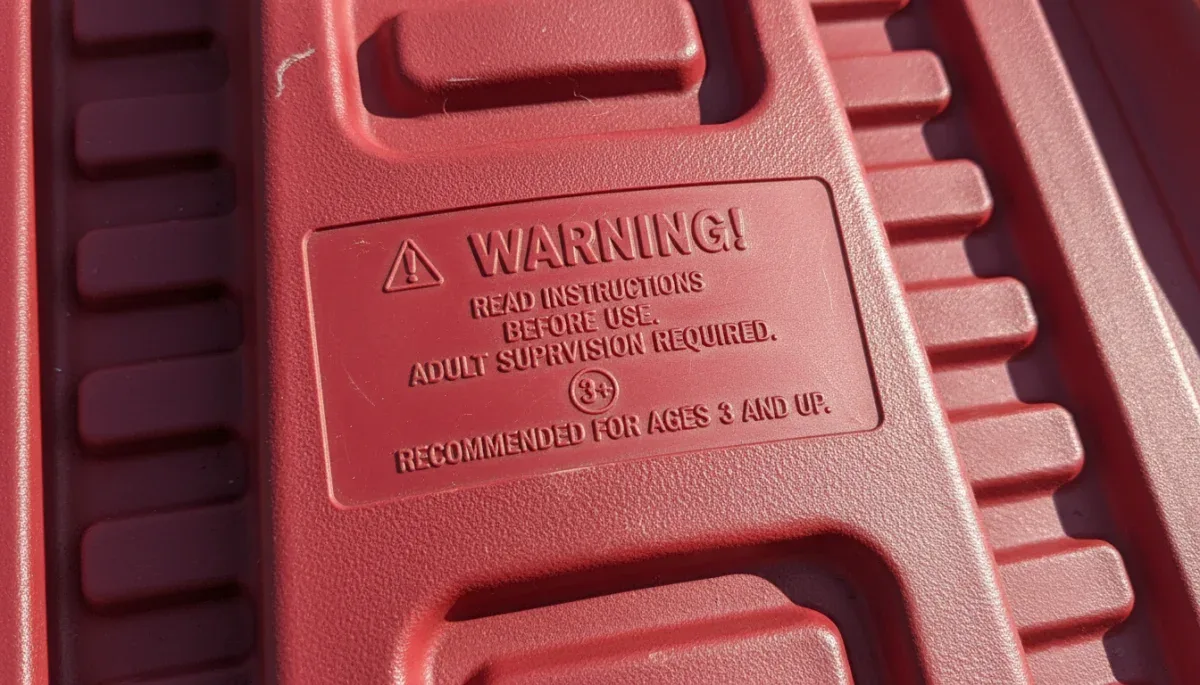
When reviewing product boxes, consumers should locate the explicit ASTM designation alongside the manufacturer's stated age minimum. Products carrying third-party certification labels or explicit testing notes demonstrate adherence to formal impact standards rather than informal marketing claims.
Matching snow gear to developmental toddler capabilities
Children between 12 months and 3 years old have high centers of gravity and developing balance systems, which make high-speed motion disorienting and dangerous. Sleds and snow accessories for this group focus exclusively on parent-controlled locomotion across flat surfaces or very gentle inclines.
Essential design features for ages one to three
- High molded seat backs that support upright posture and spine stability during movement.
- Adjustable three-point or five-point security harnesses to prevent the child from leaning out or tipping.
- Wide base footprints that resist rollover when sliding across uneven snowdrifts.
- Extra-long parent tow leashes equipped with ergonomic handles that keep pulling forces smooth and predictable.
For standalone play, lightweight scoops, snowball mold clamps, and low-density shovels marked for ages two and up present negligible impact risk while encouraging motor development without exposure to gravity-driven momentum.
Evaluating sled designs and braking for early elementary ages
Children between the ages of 4 and 7 possess improved grip strength and leg coordination, but their reaction times remain relatively slow in sudden crisis situations. Outdoor snow toys rated for this category typically introduce self-propelled sliding with strict mechanical limits on speed and steering complexity.
Saucer sleds and basic plastic roll-up sliders are common in this age bracket, yet they offer zero directional steering and minimal deceleration options. When manufacturers rate round saucers for ages four and up, they assume supervised operation on short hills that terminate in clear runout zones free of obstacles, fences, and water bodies.
Foam sleds featuring laminated bottoms and molded side handles represent a safer mechanical option for early elementary riders. Foam absorbs surface shock better than rigid brittle plastic and reduces the impact energy if two sledders accidentally collide on the course.
Selecting high-speed equipment for older children and preteens
For children aged 8 and older, manufacturer categories expand to include steerable bobsleds, heavy-duty inner tubes, and steerable snow kick scooters. At this developmental level, children have the visual tracking skills and muscular strength necessary to manipulate directional skis, handles, and mechanical foot brakes.
Performance considerations for advanced equipment
- Integrated metal or heavy composite handbrakes that provide immediate, reliable drag against packed snow.
- Steering columns linked directly to front-mounted tracking skis for controlled navigation away from obstacles.
- Heavy-gauge PVC or high-density polyethylene construction rated for sub-zero impact resistance.
- Explicit upper weight limits, ensuring the chassis does not warp or ground out under rider load.
Snow tubes sold in retail toy aisles differ substantially from commercial tubing park hardware. Inflatable vinyl models intended for older kids must feature double-welded seams and heavy cold-crack additives to prevent sudden deflation over hard-packed snow or hidden ice patches.
Recognizing structural warning signs and material durability
Material quality dictates whether a snow toy remains structurally sound or splinters into sharp shards upon contact with frozen ground. Inexpensive polymers can experience extreme cold embrittlement, a state where freezing ambient temperatures cause rigid plastics to lose elasticity and fracture under moderate impact.
Reputable manufacturers explicitly indicate the use of high-density polyethylene (often marked as HDPE) or cold-resistant additives rated down to specific temperatures, such as minus twenty degrees Fahrenheit. Avoid thin, unbranded plastic sleds that lack resin recycling codes or country-of-origin documentation on the packaging.
Ropes, grommets, and steering linkages also warrant structural scrutiny prior to seasonal purchase. Tow ropes must be securely knotted through reinforced eyelets, and steering linkages on ski-sleds should use locknuts rather than friction-fit press pins to prevent mechanical separation during downhill runs.
Implementing manufacturer gear requirements on winter slopes
Nearly all major winter gear manufacturers specify in their user manuals that children must wear protective headgear during sledding activities. While traditional bicycle helmets are common, manufacturers and safety councils recommend dual-certified winter sport helmets that satisfy ASTM F2040 standards for cold-weather impact protection and ear insulation.
Visibility represents an often overlooked component of snow safety ratings. Sleds molded in stark white, light gray, or sky blue blend into winter landscapes, making riders difficult to spot for others descending the slope. Opting for bright, high-contrast neon tones directly reduces mid-slope collision hazards.
Finally, inspect and enforce manufacturer weight thresholds meticulously. Exceeding the stated capacity degrades braking responsiveness, strains molded joints, and significantly increases descent speeds beyond what a child can manage.
At a glance
| Factor | What to know |
|---|---|
| Age ratings | Manufacturer labels denote physical coordination, reaction speed, and choke hazards rather than size. |
| Plastic durability | Cold-resistant high-density polyethylene resists catastrophic shattering on frozen terrain. |
| Control systems | Directional steering and manual drag brakes require coordination typically developed by age eight. |
| Safety gear | Winter recreational gear packaging routinely specifies wearing an ASTM-certified multi-impact helmet. |
Frequently asked questions
Do manufacturer age ratings reflect physical skill or just choking hazards?
Manufacturer ratings reflect both statutory choking hazard benchmarks and the physical coordination required to operate the toy safely. Equipment marked for children over six or eight assumes the rider possesses the reflex speed, muscle strength, and spatial judgment necessary to balance or steer downhill.
Can a toddler ride on a steerable sled with an older sibling?
No, toddlers should not share steerable sleds unless the manufacturer explicitly certifies the product for multiple riders including small children. Tandem riding on single-occupant models alters the center of gravity, impedes mechanical steering linkages, and significantly increases rollover hazards on icy ground.
What should parents look for on snow toy labels to verify safety standards?
Look for explicit references to ASTM F963 compliance on retail toy packaging, alongside manufacturer address details and clear weight boundaries. Products lacking manufacturer identification, country of manufacture, or formal age minimums should be passed over in favor of documented, fully labeled brands.
Does cold weather weaken standard plastic snow sleds?
Yes, standard plastics become brittle and prone to cracking as temperatures plunge below freezing. Look for gear made with high-density polyethylene or materials specifically treated with cold-crack additives to ensure the toy flexes upon impact instead of shattering into sharp plastic fragments.
The bottom line
Choosing the safest outdoor snow toys depends on matching your child's developmental balance and reaction speed to equipment featuring proven structural materials, clear age classifications, and reliable deceleration options. Always confirm the manufacturer's published weight limits and required helmet warnings printed on the packaging or instruction sheet before heading out to the hill.
Written by
Maria Eduarda
Maria Eduarda writes about tech & life, gift guides and seasonal toys for portalreborn.com. Each article explains how things work, compares published details such as prices, policies and program rules, and points readers to the official source before they decide.