
Comparing modular play couches for safety and fabric wear
Advertisement
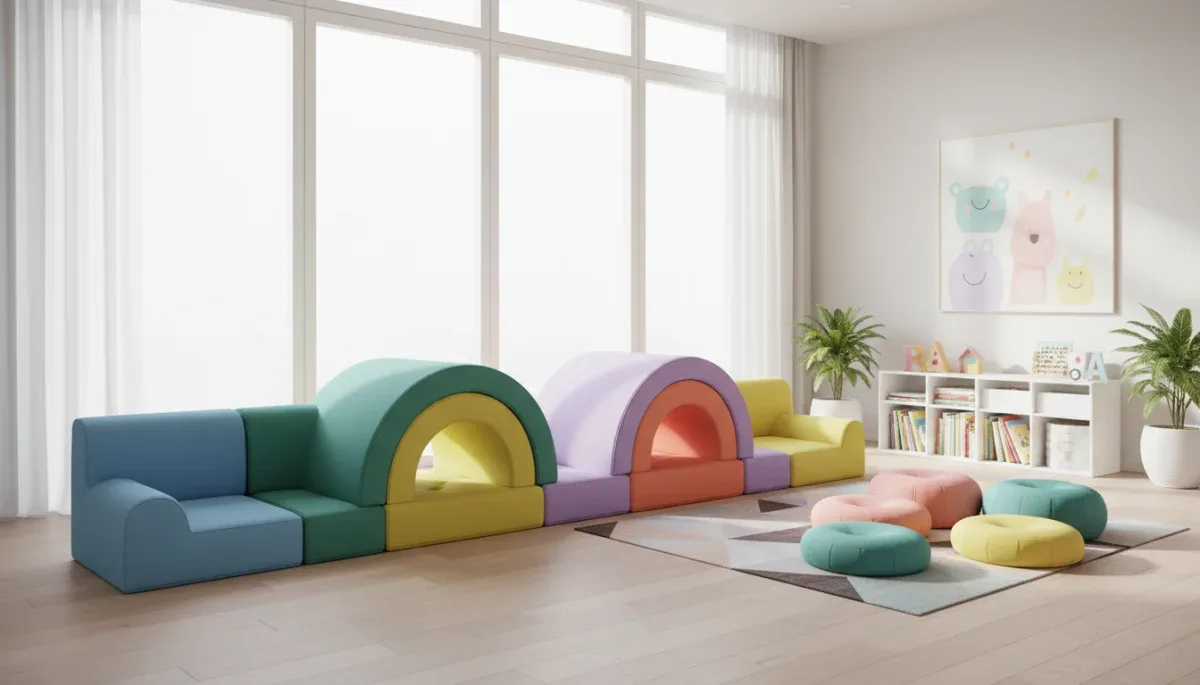
Choosing between modular play couches comes down to verifying third-party chemical safety seals on internal foam and checking standardized laboratory abrasion scores on outer covers. Comparing these products by published specifications helps families avoid off-gassing hazards and premature tears, though verifying batch-specific testing documents requires examining manufacturer disclosure pages directly.
Because children spend hours tumbling across, building with, and breathing near these foam pieces, surface marketing claims such as non-toxic or heavy-duty offer little assurance on their own. Objective standards such as CertiPUR-US, GREENGUARD Gold, OEKO-TEX, and standardized Martindale or Wyzenbeek double-rub ratings provide concrete measurements that cut through promotional language.
Understanding foam safety certifications and chemical screening
Flexible polyurethane foam makes up the core support structure of nearly every modular play couch on the consumer market. Raw polyurethane relies on chemical reactions during manufacturing that can leave residual volatile organic compounds or require stabilizer additives, making independent laboratory verification essential for indoor home environments.
Advertisement
CertiPUR-US remains the most widespread baseline standard for flexible polyurethane foam used in juvenile furniture across the United States. Managed by a nonprofit alliance of foam producers, this voluntary program tests foam samples in environmental chambers to confirm they are made without ozone depleters, mercury, lead, heavy metals, formaldehyde, or specific phthalates regulated by the Consumer Product Safety Commission.
Beyond elementary component screening, CertiPUR-US mandates that total volatile organic compound emissions remain below 0.5 parts per million during chamber tests. While CertiPUR-US evaluates the raw foam block itself, it does not evaluate adhesives used to laminate foam layers, nor does it test the outer textile covers that touch a child's skin.
Evaluating whole-product emissions with GREENGUARD Gold
GREENGUARD certification, administered by UL Solutions, approaches play couch safety through continuous chemical off-gassing measurements rather than raw recipe audits alone. A standard GREENGUARD rating tests finished items inside climate-controlled chambers to ensure that chemical emissions meet strict indoor air quality thresholds over time.
GREENGUARD Gold establishes significantly lower total volatile organic compound limits and adds specific caps on more than 360 individual health-based chemical compounds. This enhanced level is calibrated specifically for sensitive groups, including infants, young children, and elderly residents in schools, daycare centers, and healthcare environments.
Key distinctions in emission testing protocols
- Scope of testing: GREENGUARD Gold measures volatile organic compounds emitted into the ambient air, whereas basic safety rules often only restrict solid content.
- Phthalate thresholds: Gold certification requires aggregate compliance with strict limits on plasticizers that can migrate into house dust.
- Finished assembly evaluation: When an entire modular play couch holds GREENGUARD Gold status, the certification covers the foam core, lamination adhesives, internal liners, and outer fabrics together.
- Ongoing validation: Certified manufacturers must submit to routine surveillance testing to retain the right to display the UL verification mark.
When shopping for modular play couches, parents must confirm whether the GREENGUARD Gold seal applies strictly to the bare interior foam or extends to the fully assembled play set including its upholstery layer.
Fabric abrasion testing and double-rub ratings
Fabric longevity on modular play couches is measured using mechanical abrasion tests that simulate years of friction from sliding, stacking, and rough play. In North America, the textile trade relies on the Wyzenbeek test, while European and global manufacturers frequently utilize the Martindale method to quantify surface wear.
The Wyzenbeek protocol pulls a piece of cotton duck canvas or wire mesh back and forth across a fabric sample under mechanical tension until noticeable thread breakage occurs. Each back-and-forth movement equals one double rub, generating an objective numerical score that establishes commercial durability grades.
Residential upholstery generally requires a baseline rating of 15,000 double rubs to handle regular domestic sitting without fraying or thinning. Given that children use play cushions as climbing stairs, slides, and balance beams, fabrics designed for modular play couches should ideally achieve heavy-duty commercial ratings between 30,000 and 100,000 double rubs.
If a product description fails to publish a verifiable double-rub count, the fabric may consist of decorative-grade velour that can develop bald spots, pill excessively, or wear through along the corner seams under repeated playroom friction.
Material types: microsuede versus textured weave upholstery
The vast majority of modular play couches feature covers made from woven polyester microsuede, brushed micro-velvet, or textured woven twill. Each material choice produces distinct tradeoffs regarding stain release, grip for building, tactile comfort, and seam fatigue over extended ownership.
Brushed microsuede remains an industry standard because tightly structured polyester microfibers resist liquid penetration better than loosely spun yarns. Spills tend to bead on the surface momentarily, granting time to blot moisture away before liquids absorb deeply into the open-cell foam cushion underneath.
Performance differences across common play couch covers
- Brushed polyester microsuede: Delivers high frictional friction that helps angled cushion builds hold their shape without slipping apart under weight.
- Textured woven fabrics: Provide a tailored aesthetic resembling adult living room furniture, but looser yarn loops can snag on pet claws or sharp toy edges.
- Waterproof barrier liners: Internal polyurethane or polyester slipcovers positioned between foam and outer fabric stop liquid accidents from soaking into porous cushion cores.
- Removable canvas covers: Offer rugged structural stability but may feel stiff against bare skin and shrink noticeably if washed in warm water cycles.
Fabrics that carry OEKO-TEX Standard 100 certification have undergone separate independent chemical screenings to guarantee that surface dyes, finishing agents, and flame retardants do not contain harmful residual toxins.
Structural seam integrity and hardware safety considerations
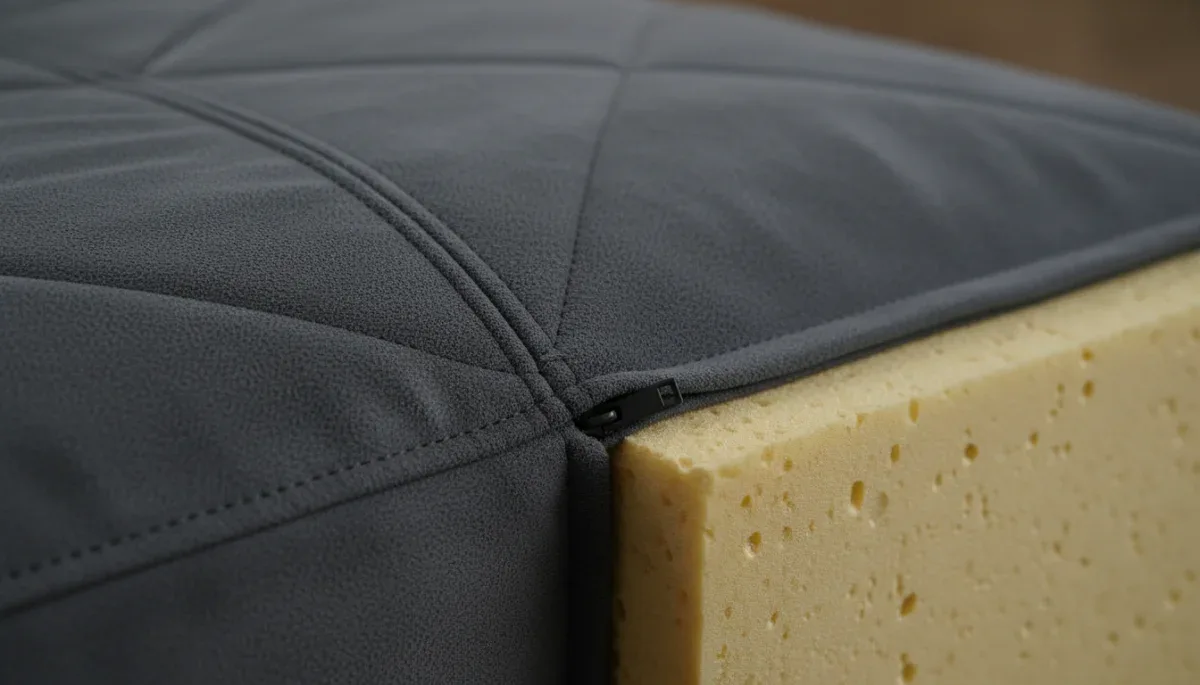
High double-rub counts prevent surface fabric from wearing thin, but physical failure on modular play couches most often occurs at stress points along exterior seams and zipper tracks. Double-stitched or bound reinforced seams distribute physical load when children jump directly onto cushion edges.
Zipper construction demands close inspection for both mechanical durability and direct child safety. Reputable manufacturers specify commercial-grade nylon coil zippers, such as those made by YKK, because metal teeth can scrape bare skin and cast-iron pulls can break under dynamic impact.
Federal child safety standards outline strict parameters regarding small parts that present potential choking hazards to toddlers. In response, compliant modular play couch brands employ lockable slider heads, fabric zipper garages, or inverted zipper teeth designed to keep mechanical pulls tucked away from curious fingers.
Checking the underside of covers reveals whether the raw internal edges are serged or overlocked. Unfinished raw fabric edges inside the cover rapidly fray during washing machine cycles, eventually clogging zipper mechanisms and causing premature structural split lines.
Maintenance protocols and cover care requirements
Sustaining both foam resilience and textile durability requires following precise maintenance practices established by the material processors. Improper laundering remains the primary cause of cover shrinkage, zipper warp, and delamination of protective interior water-resistant membranes.
Washing removable covers requires cold water settings and gentle cycles using mild detergents free from optical brighteners or synthetic fabric softeners. Fabric softeners coat technical microfibers with waxy chemical residues that degrade natural surface friction, reducing the structural cling needed to build stable cushion forts.
Air drying on a flat drying rack or line prevents dimensional shrinkage that makes covers impossible to re-stuff over dense foam cushions. High heat cycles inside residential tumble dryers melt synthetic backing glues, weaken zipper tape stitching, and permanently shrink elastane-blend textiles.
Direct exposure to sunlight during routine airing should also be carefully limited. Extended ultraviolet radiation breaks down polyurethane foam polymers through photodegradation, turning resilient white foam into brittle, yellowed crumbs that lose their firm supportive density.
At a glance
| Factor | What to know |
|---|---|
| CertiPUR-US seal | Confirms the bare polyurethane foam is manufactured without ozone depleters, heavy metals, and regulated flame retardants. |
| GREENGUARD Gold | Verifies extremely low finished-product chemical emissions inside closed indoor spaces for infants and sensitive populations. |
| Double-rub count | Measures surface abrasion resistance, with 30,000 or more cycles recommended for intense daily playroom climbing and sliding. |
| Zipper garages | Conceals mechanical zipper pulls beneath fabric pockets to prevent skin scratches, floor scuffs, and toddler tampering. |
Frequently asked questions
What does CertiPUR-US certification mean on a play couch?
It means the interior flexible polyurethane foam was formulated without harmful ozone depleters, heavy metals, formaldehyde, or specific phthalates regulated by the federal government. It also confirms baseline volatile organic compound limits below 0.5 parts per million, though it does not evaluate exterior fabrics or chemical dyes.
How high of a double-rub score does play couch fabric need?
A score of at least 30,000 double rubs is recommended for regular playroom use. Standard residential textiles require only 15,000 rubs, but active jumping, sliding, and stacking create localized stress that demands commercial-duty fabric to prevent surface thinning, fiber breakage, and premature hole formation.
Are water-resistant liner covers necessary for modular play couches?
Yes, protective inner liners provide essential defense against spilled drinks and toilet training accidents. Open-cell polyurethane foam acts like a dense sponge, absorbing liquid immediately; cleaning soaked foam is exceptionally difficult and can foster internal mildew growth if moisture reaches the core.
Can I dry clean modular play couch covers?
No, dry cleaning is generally prohibited for modular play couch covers. Dry cleaning solvents can dissolve synthetic fiber coatings, damage polyurethane waterproofing backings, and leave concentrated chemical residues within the fabric that are unsuitable for close physical contact with young children.
The bottom line
Evaluating modular play couches by their underlying component certifications rather than styling trends guarantees a safer, longer-lasting purchase for your home. Prioritize cushions built with CertiPUR-US or GREENGUARD Gold certified foam cores wrapped in commercial-grade fabrics testing above 30,000 double rubs. Before placing an order, confirm whether the advertised emission safety seals cover the complete finished product or only the raw internal foam block.
Written by
Rita Lima
Rita Lima writes about conscious living and personal growth for portalreborn.com. Each article explains how things work, compares published details such as prices, policies and program rules, and points readers to the official source before they decide.