
How to choose board games for family gatherings
Advertisement
Choosing the right board games for family gatherings requires matching game mechanics to the cognitive range, patience levels, and reading abilities present across multiple generations. This approach helps hosts avoid the common traps of drawn-out turn orders, complicated rule sheets, and early player elimination that leave children restless and older relatives alienated.
The main challenge is that games designed strictly for children often bore adults within minutes, while traditional strategy titles introduce steep learning curves and text-heavy cards that exclude emerging readers or tired relatives. Finding a middle ground means examining published game weight, setup requirements, and how information is revealed at the table.
Understanding weight and rules overhead
In the hobby tabletop community, rules overhead refers to the volume of instructions a group must memorize before taking their first turn. When hosting a gathering with varied ages, low overhead is essential. A game should take less than five minutes to explain, with core concepts that can be demonstrated through a single practice round rather than an extended reading of the rulebook.
Advertisement
Games with high rules density create gatekeeping issues. If an eight-year-old must consult a reference card on every turn, or if an older adult must track multiple exceptions to basic movement, participation becomes a chore. The ideal title features simple individual actions that combine to produce interesting choices. For example, card-drafting games where players simply choose one card and pass the remaining hand provide strategic depth without requiring complex positional awareness on a physical board.
Before purchasing or introducing a title, review the published age recommendation alongside community weight ratings found on database platforms such as BoardGameGeek. Publishers often list an age rating based on mandatory safety testing rather than developmental suitability. A box marked for ages eight and up might physically be safe for a younger child, but the strategic decision space or small-part manipulation might still present an obstacle during actual play.
Core criteria for rules evaluation
- Turn structures that consist of a single clear decision such as draw, place, or trade.
- Open visual boards that allow experienced players to assist without managing another player's hand.
- Rules summaries printed directly on player boards using clear iconography rather than walls of text.
- Absence of fiddly micro-rules that trigger only during unusual edge cases.
Minimizing downtime with simultaneous turns
Downtime is the interval between a player completing their turn and getting to act again. During large family events, long downtime is the single most common reason young players lose focus and wander away, or adult players check their phones. Sequential games with high analytical depth, where players spend minutes calculating mathematical outcomes, quickly stall group energy.
Simultaneous play mechanics largely eliminate this problem. In roll-and-write or flip-and-write titles, one player rolls common dice or reveals a shared card, and every participant records the result on their individual scoresheet at the same time. Because everyone acts together, the game moves at the pace of the fastest collective rhythm, keeping engagement steady across the table.
Drafting titles operate on a similar principle. Everyone looks at an initial set of cards, selects one simultaneously, reveals them together, and passes the remainder to the next chair. These formats support higher player counts without multiplying the overall playing time, making them well suited for larger holiday gatherings where groups easily expand beyond four or five people.
Managing literacy requirements and visual design
Literacy variance is an unavoidable factor when early elementary school children play alongside adults. If a game relies on hidden cards with full paragraphs of text, emerging readers must either reveal their private information to ask for help or make arbitrary decisions that diminish their enjoyment. Similarly, small fonts, poor contrast, and overly complex iconography can create strain for older adults with declining eyesight.
When selecting board games for family gatherings, prioritize titles that use open information or intuitive iconography. Games that communicate state through color, distinct silhouettes, and clear numeric values reduce cognitive friction. Color-blind-friendly graphic design, where symbols accompany colors to differentiate suits or resources, ensures that all relatives can participate independently.
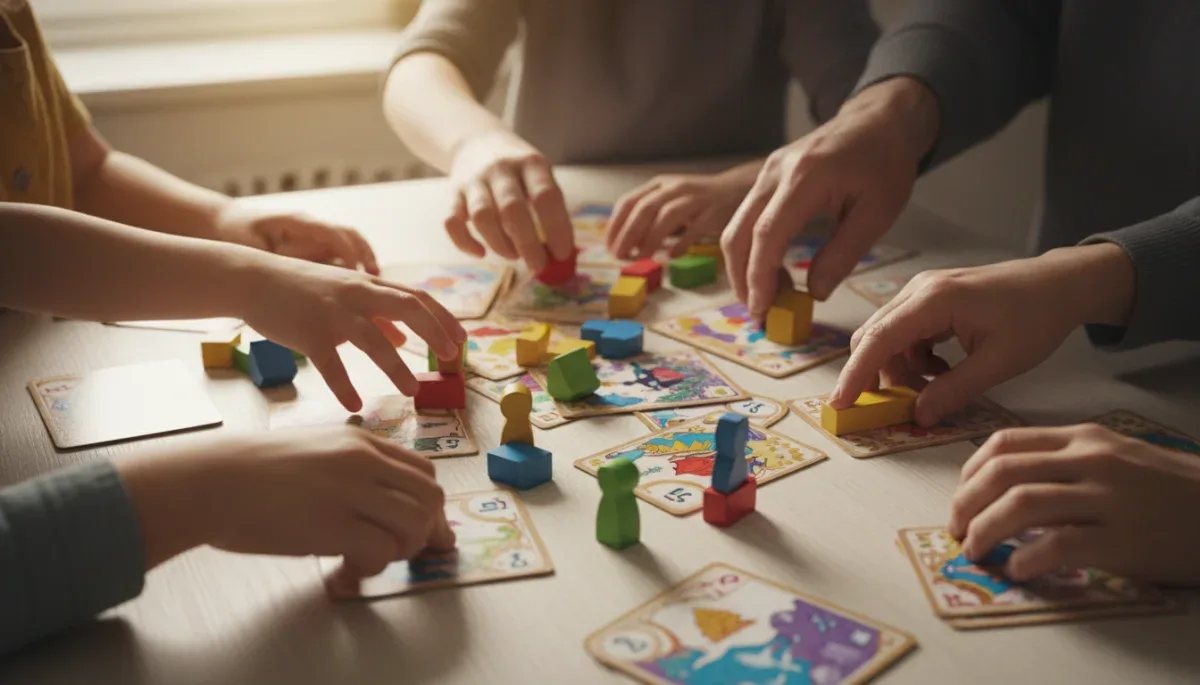
Dexterity games represent an alternative approach that bypasses reading requirements entirely. Titles centered on balancing wooden blocks, flicking discs, or arranging physical components evaluate hand-eye coordination rather than reading comprehension. These physical mechanics naturally level the playing field, as young children frequently possess the focus and fine motor precision to compete directly with adults without needing modified rules.
Visual and physical elements to check
- Card text limited to titles and numbers rather than multi-sentence ability descriptions.
- High-contrast printing that remains legible in lower dining room lighting.
- Sturdy wooden or thick cardboard pieces that are easy for both small hands and arthritic fingers to grip.
- Distinct symbols paired with colors to accommodate color vision deficiencies.
Balancing competition with cooperative formats
Direct player-versus-player conflict can quickly sour a casual family evening. Aggressive mechanics, such as stealing resources, attacking another player's territory, or blocking an opponent from making a legal move, often elicit strong emotional reactions from younger children. These zero-sum dynamics can leave less competitive family members feeling targeted or discouraged early in the session.
Cooperative board games solve this issue by uniting every participant against an automated game system. In a cooperative structure, players win or lose as a single unit, discussing options openly and pooling their unique player abilities to solve a common puzzle. This setup allows adults and older siblings to guide younger participants through strategic trade-offs naturally, without taking over their turns completely.
To avoid the common cooperative pitfall known as quarterbacking, where one dominant player dictates every move, look for designs that restrict communication or implement real-time elements. Some cooperative games enforce silence during specific phases or limit the sharing of precise card values, ensuring that each family member retains agency over their individual actions.
Evaluating player counts and table space
Most traditional modern board games are engineered specifically for three to four players. Family gatherings, however, routinely assemble six, eight, or ten people who want to share a single activity. Attempting to force a four-player game into a larger group by creating informal teams often leaves the secondary partners disengaged and bored.
Examine the official box specifications for true scalability. Many party-style deduction, drawing, or word-association games scale naturally up to eight or twelve participants without extending the duration of the match. For very large gatherings, splitting into two separate tables with four-player games of different complexities is often far more effective than trying to find a single title that accommodates an entire room.
Physical footprint is an equally practical consideration. Holiday tables are frequently crowded with serving dishes, drinks, and decor. Games that require sprawling individual boards, massive card markets, and multiple component trays can be difficult to manage without accidental spills or knocked-over pieces. A compact layout with a centralized board keeps play tidy and prevents components from drifting out of reach of players seated at the ends of the table.
Practical hosting considerations
- Verify that the maximum player count does not artificially stretch game duration beyond sixty minutes.
- Ensure components fit comfortably within reach of all chairs without crowding beverage glasses.
- Keep a separate, flat side table available for rulebooks, spare tokens, and discarded boxes.
- Consider splitting groups larger than eight into two parallel games matched by play style.
At a glance
| Selection factor | What to know |
|---|---|
| Turn speed | Choose simultaneous actions or short individual turns to prevent younger players from losing interest. |
| Reading burden | Opt for strong visual iconography over text-heavy cards to accommodate emerging readers and older eyes. |
| Conflict style | Favor cooperative play or indirect scoring races over direct resource theft and aggressive blocking. |
| Group sizing | Check actual maximum player counts to ensure the game remains functional without stretching match length. |
Frequently asked questions
How long should a family gathering board game last?
A duration between twenty and forty-five minutes is optimal for mixed ages. This timeframe keeps younger participants from burning out their attention spans while allowing adults to complete a satisfying strategic arc without feeling that the game is dragging on indefinitely.
Can trivia games work well across different generations?
Standard trivia rarely works because cultural knowledge bases vary drastically across decades. If you choose a trivia format, select games that award points for guessing ranges, wagering on relative accuracy, or providing age-differentiated question decks so children and grandparents have comparable chances.
What should I do if a family member gets frustrated by losing?
Switch to a cooperative game where everyone works toward a shared objective against the game system. Shared victories celebrate collective problem-solving, and shared defeats soften individual frustration, reframing the experience as a group challenge rather than a personal failure.
Are party games better than strategy games for reunions?
Party games handle higher player counts and diverse attention spans more reliably than deep strategy games. However, selecting light strategy titles with clear visual puzzles often provides a richer, calmer experience than high-energy party games that rely on loud shouting or frantic physical gestures.
The bottom line
Selecting effective board games for family gatherings comes down to finding accessible mechanics that minimize turn downtime and eliminate severe reading barriers. Prioritizing cooperative play, clear iconography, and modest playtimes keeps multi-generational groups engaged without frustrating younger children or tiring older relatives. Before buying a new title for an upcoming gathering, always confirm the true playing time and maximum player count printed on the manufacturer's official product listing.
Written by
Maria Eduarda
Maria Eduarda writes about tech & life, gift guides and seasonal toys for portalreborn.com. Each article explains how things work, compares published details such as prices, policies and program rules, and points readers to the official source before they decide.